Keeping doing your duties with faith and courage. Good times will come and deep sorrows will be transcended.
The nature of the world is that invariably in everyone’s life, deep tragedies come which can completely shock one to the core. It can have very devastating effect on people. How to cope with that? How to respond to that? When we look around, if we are perceptive we see that many others have had such deeply traumatic experiences and are somehow carrying on. That gives us courage.
We hear from Sri Bhagavan’s teachings in Bhagavad Gita that the world is duhkhaalayam – that is, a place meant specifically for sorrow. We also hear teachings that janma mrityu jaraa vyaadhi duhkha dosha anudarshanam. That is, we should always keep reminding ourselves that this world is filled with sorrow in the form of death, old age, disease and the like. That teaching also comes in Bhagavad Gita.
When we hear such things, it gives us some solace and courage to face reality.
We read scriptures, and from them we get to see what unbearable tragedies and pains great characters went through, and how at the end, they found deep lasting happiness and peace.
Bharata had every reason to fall into depression, or to complain. In a highly unexpected turn of events, Bharata lost his father, Dasharath, and his elder brother, Sri Rama, who was like guru, guide, friend and father figure for him, had been exiled to the forest. Sita devi had also gone with Sri Ram, and Lakshman too went with them.
Bharat had to come to terms with this agonizing turn of events.
And worst, in one sense, Bharat was himself a main character in bringing about this tragic turn of events (since Kaikeyi had done all this on behalf of Bharat only). Though innocent, Bharat would blame himself as being the cause of suffering for everyone.
Bharat showed highest character when he rejected the throne despite being requested by the kula guru – the great sage Vasishta.
He had a hope- that he would go and convince Sri Ram, and Lord Ram would then come back to Ayodhya and rule the kingdom. Bharat went to where Sri Ram was, and pleaded with Him to return. But Sri Ram was bound by His word and could not return before 14 years. Hence, Bharat faced another setback or reversal.
Lakshman too served Sri Ram during the exile term. But he was at least in direct physical association of Sri Ram.
In contrast, Bharat had been told by the Lord to return back. And Bharat had to take charge of administration of the kingdom during Sri Ram’s absence. So, on top of the tragic pain that he was enduring, the gigantic responsibility of ruling a big kingdom was thrust on his shoulders. Bharat did not complain. As a surrendered devotee of the Lord, Bharat accepted wherever the Lord placed him.
And as described in Srimad Bhagavatam, Canto 9, Bharat led such a deeply austere life during those 14 years. Perhaps even more austere than what one would lead in a forest exile.
And yes, at long last, things took an upward turn. Coronation or pattaabhishekam for Sri Sita Ram took place, and the deep pains and sorrows were healed.
Similarly, even Kaikeyi must have felt such deep agony in the aftermath of the tragedies that took place. Because she was directly responsible. But, she transformed herself soon into the good lady that she was, and deeply repented for her actions. And as it is said, time is a good healer. So, when Sri Ram returned and coronation took place, Kaikeyi too was pacified.
In the life of the Pandavas, we see so many tragedies and painful situations. They lost their father early, and then they were denied their rights, and plots were made against them. They and Draupadi were deeply humiliated in public. Later they had to wage a war against their own relatives. Arjuna’s son Abhimanyu was killed by deception. And the 5 children of Draupadi were cruelly killed. They had to undergo all such unbearable pains. But with the Lord always by their side, they, with deep courage and faith, were able to transcend all of it.
Many many such examples of great personalities facing deep pains occur in our scriptures. It teaches us, as also told by Mother Sita, that if one perseveres on, then good days will certainly come, and sorrows will be transcended and happiness will come.
Even in the life of Sri Ramanujar, deep sorrows and setbacks can be seen. By following the path of bhakti and sharanagati taught by Ramanujar, we can all put an end to pains, and attain happiness and peace.
-

-
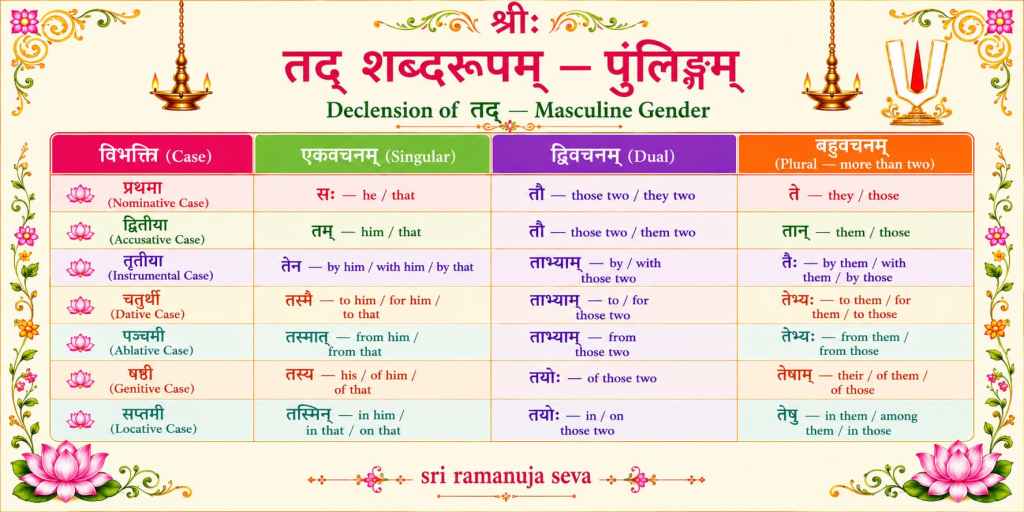
Learn simple Sanskrit
विभक्ति (Case) एकवचनम् (Singular) द्विवचनम् (Dual) बहुवचनम् (Plural — more than two) प्रथमा (Nominative Case) सः — he / that तौ — those two / they two ते — they / those द्वितीया (Accusative Case) तम् — him / that तौ — those two / them two तान् — them / those तृतीया (Instrumental Case) तेन — by him / with him / by that ताभ्याम् — by / with those two तैः — by them / with them / by those चतुर्थी (Dative Case) तस्मै — to him / for him / to that ताभ्याम् — to / for those two तेभ्यः — to them / for them / to those पञ्चमी (Ablative Case) तस्मात् — from him / from that ताभ्याम् — from those two तेभ्यः — from them / from those षष्ठी (Genitive Case) तस्य — his / of him / of that तयोः — of those two तेषाम् — their / of them / of those सप्तमी (Locative Case) तस्मिन् — in him / in that / on that तयोः — in / on those two तेषु — in them / among them / in those Examples for each vibhakti are given below:
विभक्तिः (Case) एकवचनम् (Singular) द्विवचनम् (Dual) बहुवचनम् (Plural) प्रथमा (Nominative) सः छात्रः अस्ति। — He is a student. तौ छात्रौ स्तः। — Those two are students. ते छात्राः सन्ति। — They are students. द्वितीया (Accusative) अहं तम् पश्यामि। — I see him. अहं तौ पश्यामि। — I see those two. अहं तान् पश्यामि। — I see them. तृतीया (Instrumental) अहं तेन सह गच्छामि। — I go with him. अहं ताभ्याम् सह गच्छामि। — I go with those two. अहं तैः सह गच्छामि। — I go with them. चतुर्थी (Dative) अहं तस्मै फलम् ददामि। — I give a fruit to him. अहं ताभ्याम् फलानि ददामि। — I give fruits to those two. अहं तेभ्यः फलानि ददामि। — I give fruits to them. पञ्चमी (Ablative) अहं तस्मात् पुस्तकम् प्राप्नोमि। — I receive a book from him. अहं ताभ्याम् पुस्तकानि प्राप्नोमि। — I receive books from those two. अहं तेभ्यः पुस्तकानि प्राप्नोमि। — I receive books from them. षष्ठी (Genitive) एतत् तस्य पुस्तकम् अस्ति। — This is his book. एतत् तयोः गृहम् अस्ति। — This is the house of those two. एतत् तेषाम् विद्यालयः अस्ति। — This is their school. सप्तमी (Locative) तस्मिन् ग्रामे मन्दिरम् अस्ति। — There is a temple in that village. तयोः ग्रामयोः मन्दिरे स्तः। — There are temples in those two villages. तेषु ग्रामेषु मन्दिराणि सन्ति। — There are temples in those villages. Similar posts – Shabd roop of yushmad is here.
-
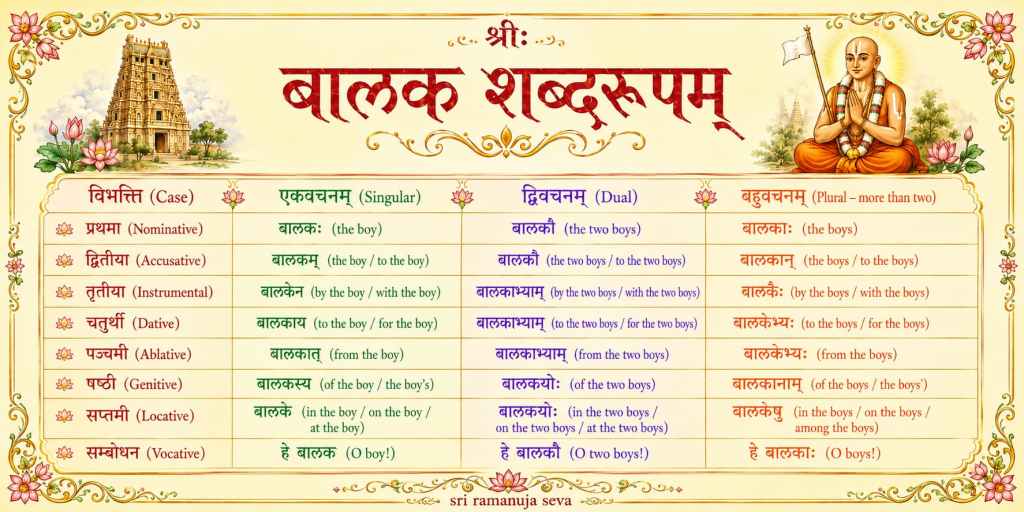
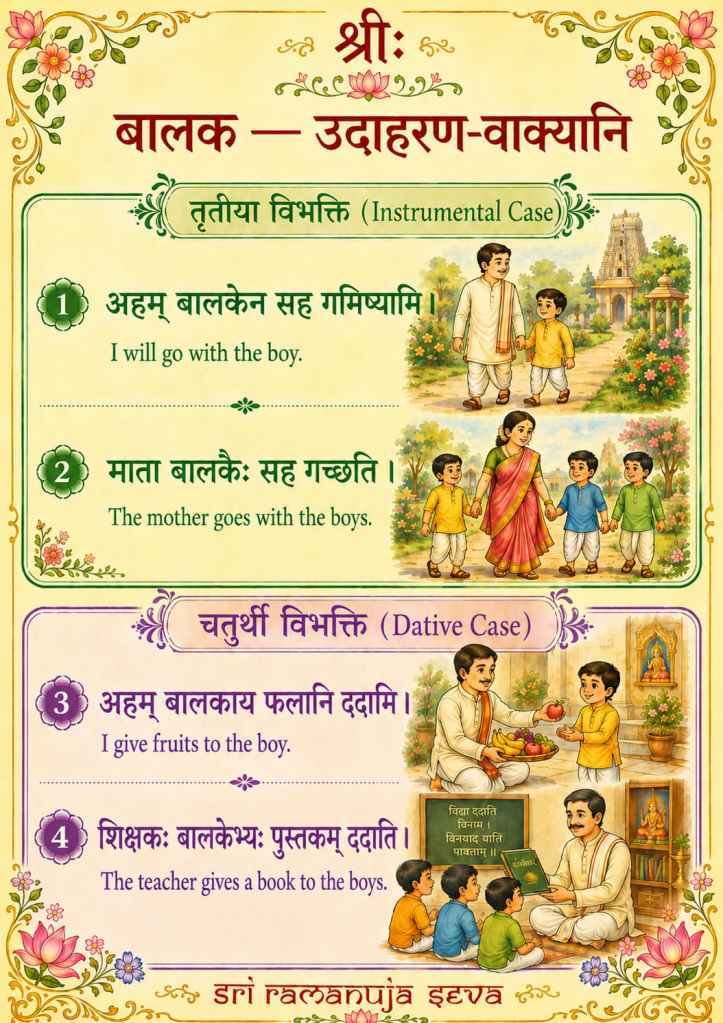
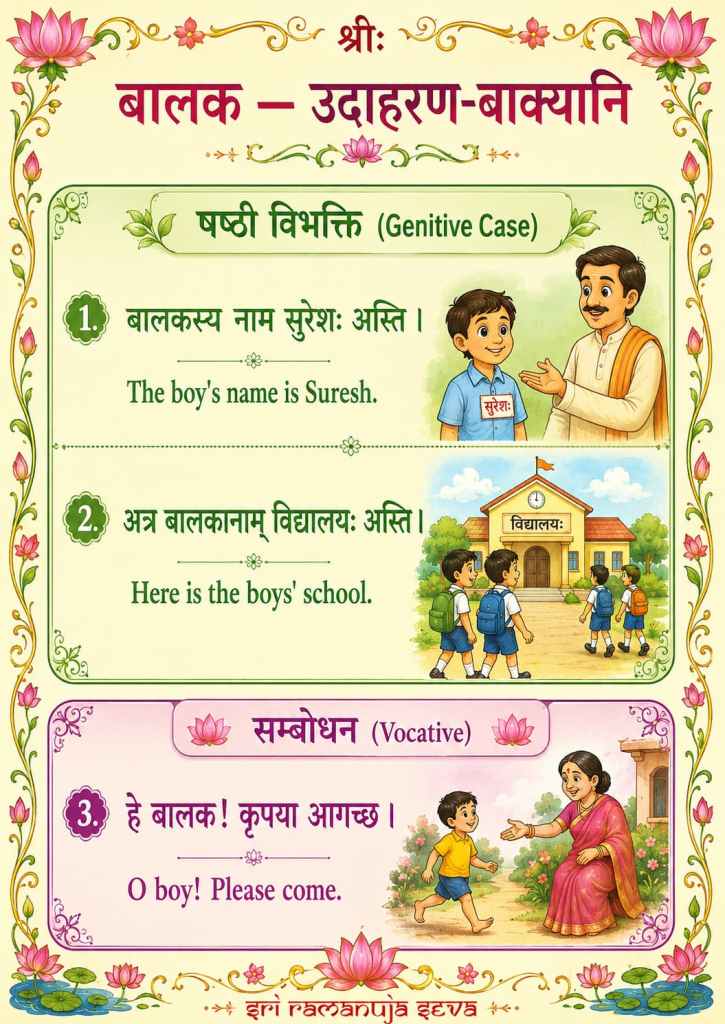
In this post, you’ll find शब्दरूपम् table for बालक (अकारान्त पुल्लिङ्ग word) . And some example sentences to illustrate various forms of the word,
विभक्ति (Case) एकवचनम् (Singular) द्विवचनम् (Dual) बहुवचनम् (Plural – more than two) प्रथमा (Nominative) बालकः (the boy) बालकौ (the two boys) बालकाः (the boys) द्वितीया (Accusative) बालकम् (the boy / to the boy) बालकौ (the two boys / to the two boys) बालकान् (the boys / to the boys) तृतीया (Instrumental) बालकेन (by the boy / with the boy) बालकाभ्याम् (by the two boys / with the two boys) बालकैः (by the boys / with the boys) चतुर्थी (Dative) बालकाय (to the boy / for the boy) बालकाभ्याम् (to the two boys / for the two boys) बालकेभ्यः (to the boys / for the boys) पञ्चमी (Ablative) बालकात् (from the boy) बालकाभ्याम् (from the two boys) बालकेभ्यः (from the boys) षष्ठी (Genitive) बालकस्य (of the boy / the boy’s) बालकयोः (of the two boys) बालकानाम् (of the boys / the boys’) सप्तमी (Locative) बालके (in the boy / on the boy / at the boy) बालकयोः (in the two boys / on the two boys / at the two boys) बालकेषु (in the boys / on the boys / among the boys) सम्बोधन (Vocative) हे बालक (O boy!) हे बालकौ (O two boys!) हे बालकाः (O boys!)
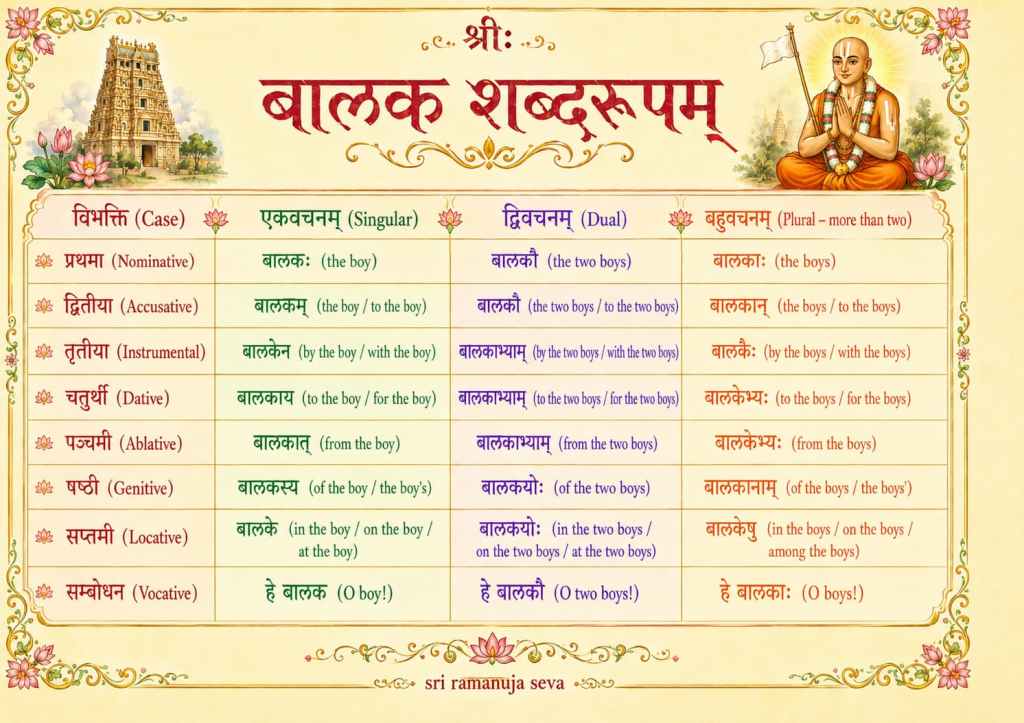
You can see shabd roop tables of a few other words here: सीता , राम , अस्मद् , युष्मद्
More posts related to Sanskrit are here: Sanskrit posts -
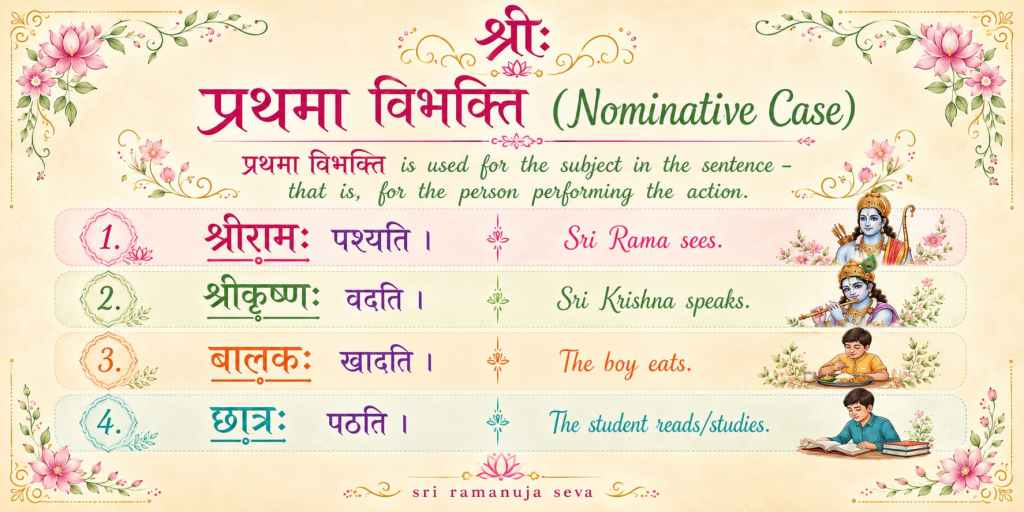
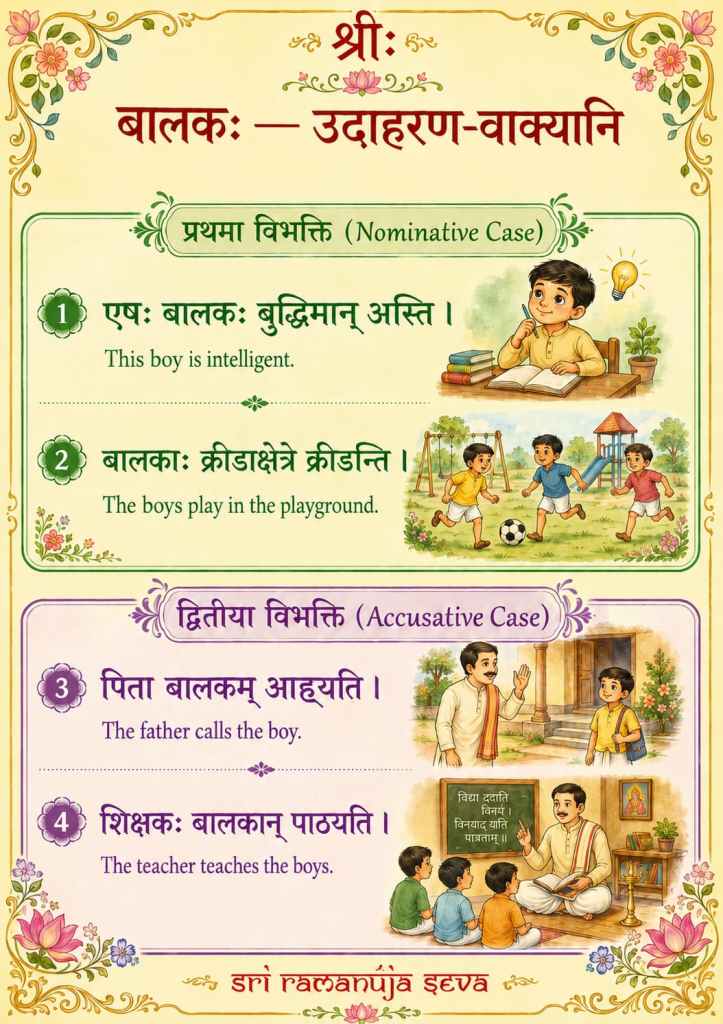
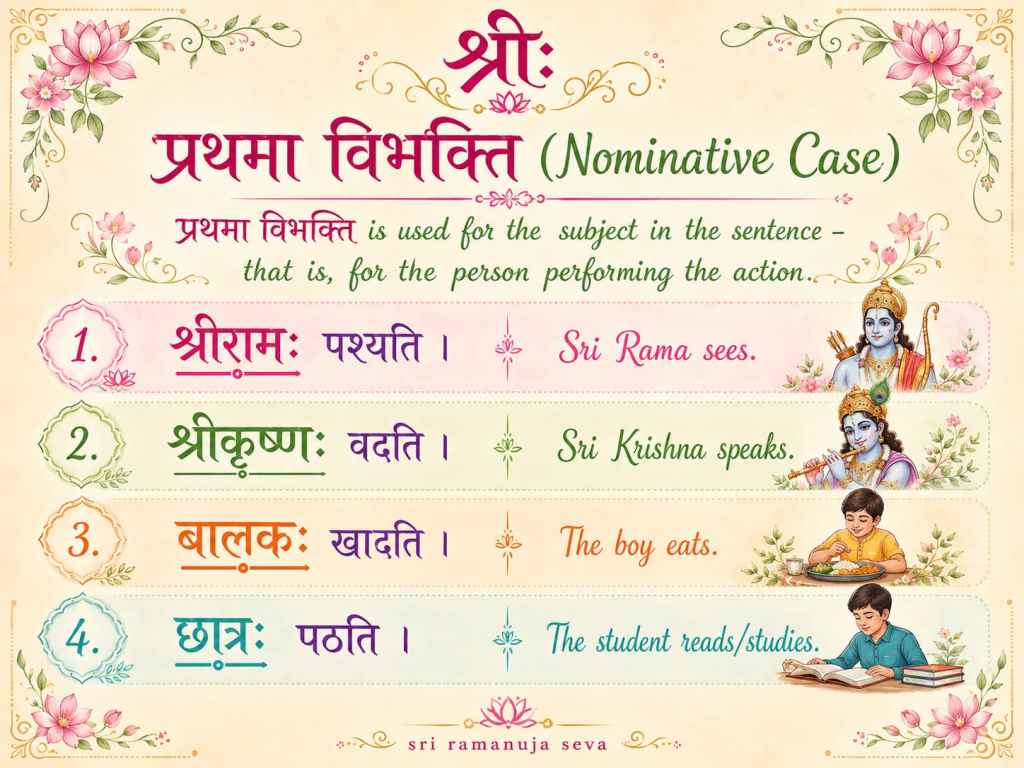
प्रथमा विभक्ति (Nominative Case)
This is used for the subject in the sentence. The subject is the person performing the action, the doer. The sentence will have an action (verb). प्रथमा विभक्ति is used when mentioning the person performing that action.
In the sentence, identify what the action is, and then see who is performing that action, and use प्रथमा विभक्ति for that person (or persons).- श्रीरामः पश्यति ।
- Sri Rama sees.
- Sri Rama is the one performing the action (of seeing). Hence, प्रथमा विभक्ति is used for Sri Rama. The प्रथमा विभक्ति एकवचन form of श्रीराम is श्रीरामः .
- श्रीकृष्णः वदति ।
- Sri Krishna speaks.
- Sri Krishna is the doer of the action (of speaking). Hence, प्रथमा विभक्ति is used for Sri Krishna. The प्रथमा विभक्ति एकवचन form of श्रीकृष्ण is श्रीकृष्णः .
- बालकः खादति ।
- The boy eats.
- The action is that of eating. And the boy is the doer of the action. Hence, प्रथमा विभक्ति is used for the boy. The प्रथमा विभक्ति एकवचन form of बालक is बालकः .
- छात्रः पठति ।
- The student reads/studies.
- The verb (action) is to read or to study. And the student is the one doing that. Hence, प्रथमा विभक्ति is used for the student. The प्रथमा विभक्ति एकवचन form of छात्र is छात्रः .
Similar posts: तृतीया विभक्तिः examples
- श्रीरामः पश्यति ।
-
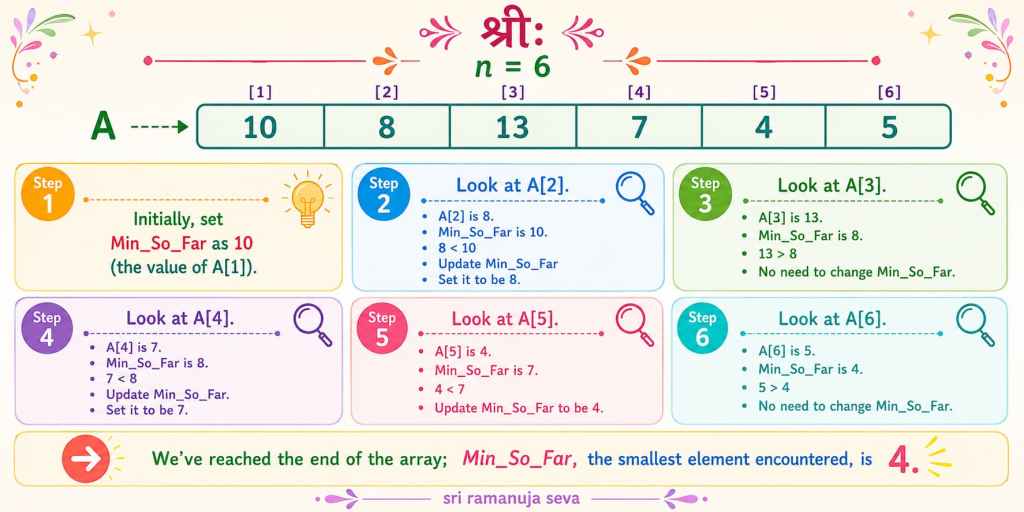
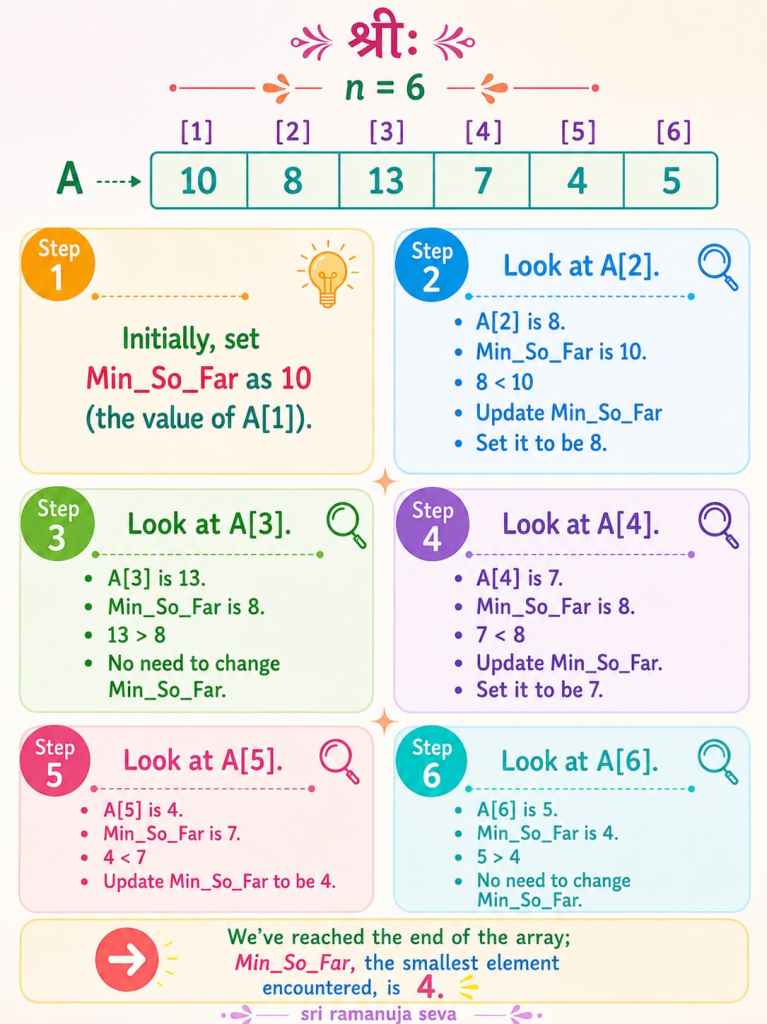
Task – Find the smallest value in an array.
Now, if we are told that the array is already sorted (say, in ascending order), then our task is trivially done, The answer is direct. The 1st element in the array is the minimum value.
e.g. Let’s say the array is: 5 | 12 | 20 | 22 | 31 | 42
‘5’, the 1st element in the sorted array is the minimum element.
We are going to assume that the array is not sorted.
Lets say the array has n elements.
- In order to find the minimum value, we necessarily (compulsorily) need to look at all the n elements of the array.
- Why so?
- Any element in the array could be the minimum. Hence, we cannot afford to ignore or skip any element, since that element may well be the minimum.
So, we have established that we need to look at each and every element of the array.
Let’s do one thing:
We’ll keep track of the smallest value we’ve encountered so far. That is, as the traverse the array element-by-element, we’ll make note of the smallest value we’ve encountered so far.
When we’ve traversed the entire array, that is, when we’ve looked at each and every element of the array, the smallest value encountered among these elements is simply the minimum value in the array
Example:
Array A, having n = 5 elements.
10 | 13 | 8 | 6 | 11
The array elements are indexed from 1 to 5. (That is, A[1] is 10; A[2] is 13, and so on,)- We look at the 1st element – A[1], which is 10.
- We’ve looked at only one element so far. So, the smallest value we’ve encountered so far is 10. We’ll store this in a variable called Min_So_Far (this variable keeps track of the smallest value encountered so far.)
- We’ve looked at only one element so far. So, the smallest value we’ve encountered so far is 10. We’ll store this in a variable called Min_So_Far (this variable keeps track of the smallest value encountered so far.)
- Next, we go to the next element – A[2], which is 13.
- We compare this with Min_So_Far, which is 10,
- The minimum value we’ve encountered so far is 10, and the current element (A[2]) is 13.
- So, the minimum value we’ve encountered so far remains as 10, No change.
- Look at the next element (A[3]), which is 8.
- Compare this with Min_So_Far, which is 10.
- Current element (8) is less than Min_So_Far (10).
- So, the minimum value we’ve encountered so far is actually 8. We need to update Min_So_Far. Set Min_So_Far to be 8,
- We go on to A[4], which is 6,
- Min_So_Far is 8.
- A[4] is less than Min_So_Far.
- so, again, we need to update Min_So_Far. Set Min_So_Far to be 6. (That is, 6 is the smallest value we’ve encountered so far.)
- We go on to A[5], wbich is 11.
- Min_So_Far is 6.
- Min_So_Far is less than A[5]. So, no need to change Min_So_Far. The smallest value we’ve encountered remains 6.
- We’ve reached the end of the array. No more elements to look at. We’ve looked at each and every element of the array, and Min_So_Far (that is, the smallest value encountered so far) is 6. That is, in other words, 6 is the smallest value in the entire array.
- Our task was to find the smallest value in the array. So, our task is successfully accomplished.
Let’s look at another example. (Depicted in the following image)
Pseudo-code
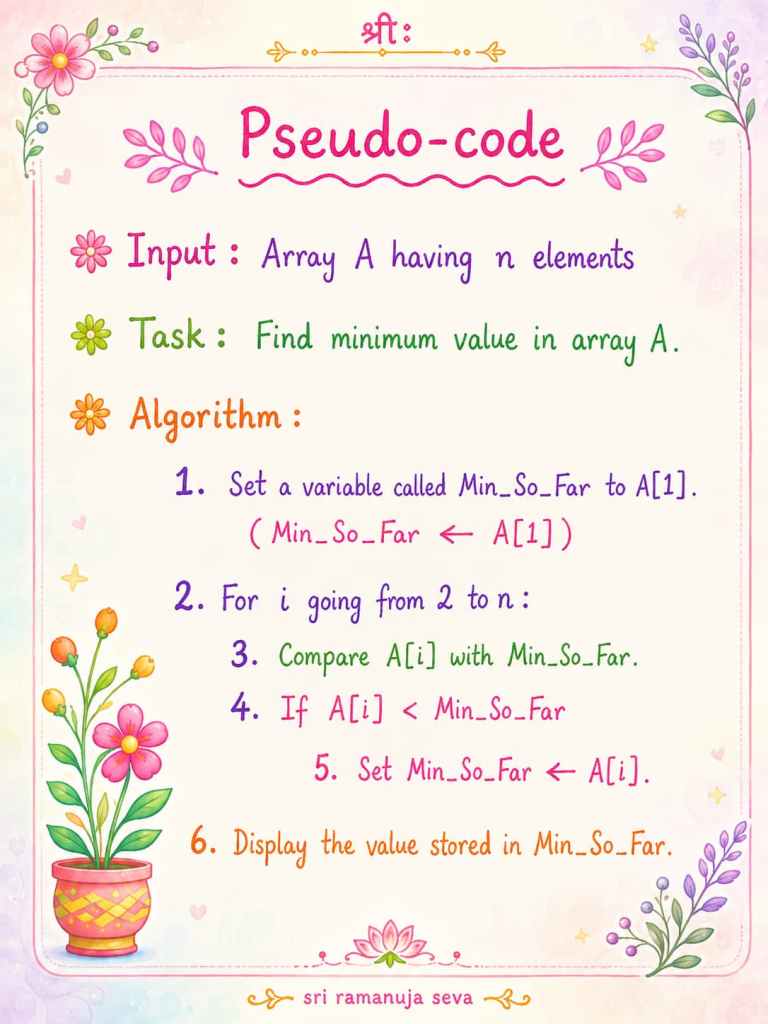
Here’s the pseudo-code for the algorithm:
Some comments on the above pseudo-code:
- Line 1: Initially, we’ve encountered only one element so far. Hence, Min_So_Far is set to A[1].
- Line 2: We run a loop from the 2nd element to the last element.
- Lines 3 to 5: Each time we encounter an element, we compare it with Min_So_Far, and if it is less than Min_So_Far, we update Min_So,Far.
- Line 6: We are now out of the loop. The value in Min_So_Far is the smallest value in the array. Display it.
Time Complexity/Running time analysis
- Line 1 takes constant, that is, O(1), time. (We just make an assigment.)
- SImilarly, Line 6 (displaying the min value) takes O(1) time.
- In Lines 2 to 5, there is a for loop.
- n-1 iterations. That is, O(n) iterations.
- In each iteration, we make a comparison, which is an O(1) time operation.
- In each iteration, optionally we make an assigment. That is also an O(1) time operation.
- So, time required in a single iteration is O(1).
- Therefore, time required for O(n) iterations is O(n). \
- n-1 iterations. That is, O(n) iterations.
- Hence, combining the times mentioned above: O(1) + O(1) {for Lines 1 and 6} + O(n) {for the loop}, the time complexity of the algorithm is O(n).
- That is, it is a linear-time algorithm (The running time is a linear function of the input size in big-O notation.)
Similar posts on algorithms: How to insert element in an array? , Selection Sort Algorithm
-
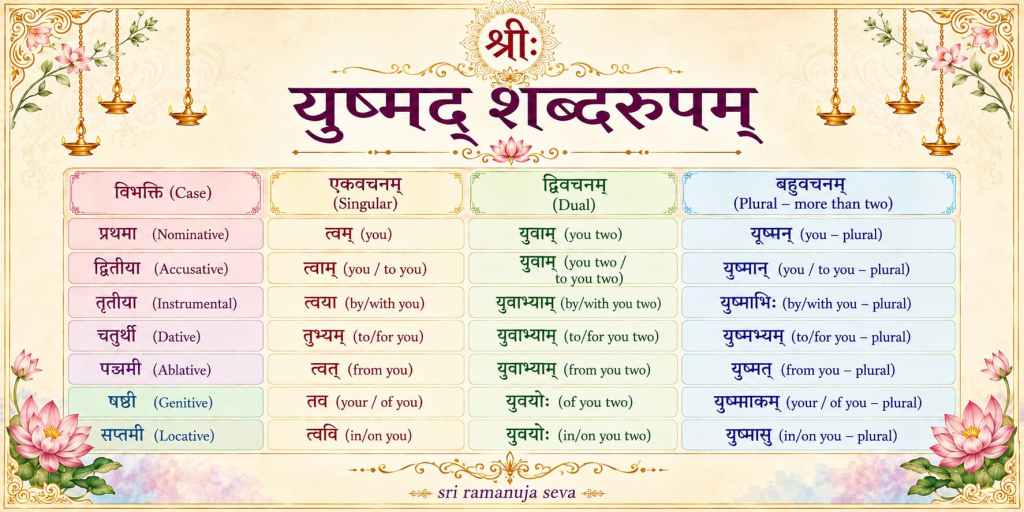
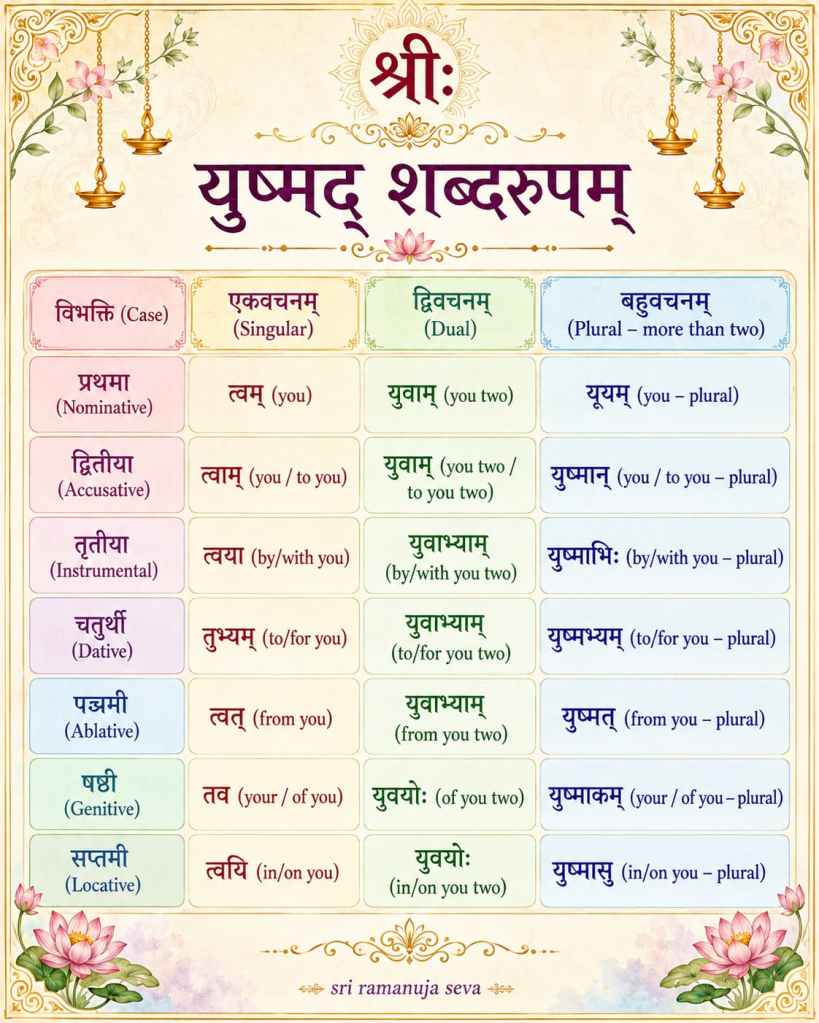
विभक्ति (case) एकवचनम् (singular) द्विवचनम् (dual) बहुवचनम् (plural) (more than two) प्रथमा (nominative) त्वम् (you) युवाम् (you two) यूयम् (you – plural) द्वितीया (accusative) त्वाम् (you / to you) युवाम् (you two / to you two) युष्मान् (you / to you -plural ) तृतीया (instrumental) त्वया (by/with you) युवाभ्याम् (by/with you two) युष्माभिः (by/with you plural) चतुर्थी (dative) तुभ्यम् (to / for you) युवाभ्याम् (to /for you two) युष्मभ्यम् (to / for you -plural ) पञ्चमी (Ablative) त्वत् (from you) युवाभ्याम् (from you two) युष्मत् (from you -plural ) षष्ठी (genitive) तव (your / of you) युवयोः (of you two) युष्माकम् (of you -plural ) सप्तमी (locative) त्वयि (in/on you) युवयोः (in/on you two) युष्मासु (in/on you -plural) - प्रथमा विभक्ति (nominative case)
- त्वम् कुत्र गच्छसि ।
- Where are you going? (Where do you go?)
- युवाम् पठथः ।
- You two study.
- यूयम् क्रीडथ ।
- You (plural) play.
- You (plural) play.
- त्वम् कुत्र गच्छसि ।
- द्वितीया विभक्ति (accusative case)
- अहम् त्वाम् पश्यामि ।
- I see you.
- I see you.
- अहम् त्वाम् पश्यामि ।
- तृतीया विभक्ति (instrumental case)
- रामः त्वया सह गच्छति ।
- Rama goes with you.
- Rama goes with you.
- रामः त्वया सह गच्छति ।
- चतुर्थी विभक्ति (dative case)
- पिता तुभ्यम् फलम् ददाति।
- Father gives fruit to you.
- Father gives fruit to you.
- पिता तुभ्यम् फलम् ददाति।
- पञ्चमी विभक्ति (ablative case)
- अहम् त्वत् पुस्तकम् गृह्णामि ।
- I take a book from you.
- I take a book from you.
- अहम् त्वत् पुस्तकम् गृह्णामि ।
- षष्ठी विभक्ति (genitive case)
- तव नाम किम् अस्ति ।
- What is your name?
- What is your name?
- तव नाम किम् अस्ति ।
- सप्तमी विभक्ति (locative case)_
- मम युष्मासु विश्वासः अस्ति ।
- I have faith in you all.
- मम युष्मासु विश्वासः अस्ति ।
You can shabd roop for other words here: अस्मद् , सीता, राम , बालक
- प्रथमा विभक्ति (nominative case)
-
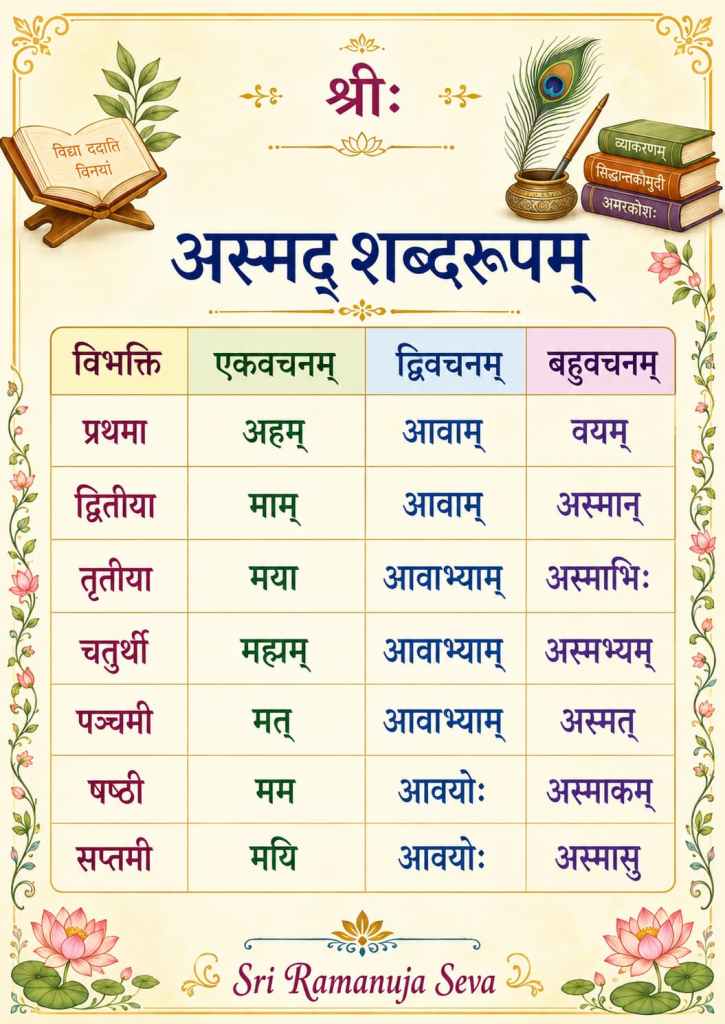
विभक्ति (case) एकवचनम् (singular) द्विवचनम् (dual) बहुवचनम् (plural) प्रथमा अहम् आवाम् वयम् द्वितीया माम् आवाम् अस्मान् तृतीया मया आवाभ्याम् अस्माभिः चतुर्थी मह्यम् आवाभ्याम् अस्मभ्यम् पञ्चमी मत् आवाभ्याम् अस्मत् षष्ठी मम आवयोः अस्माकम् सप्तमी मयि आवयोः अस्मासु Examples:
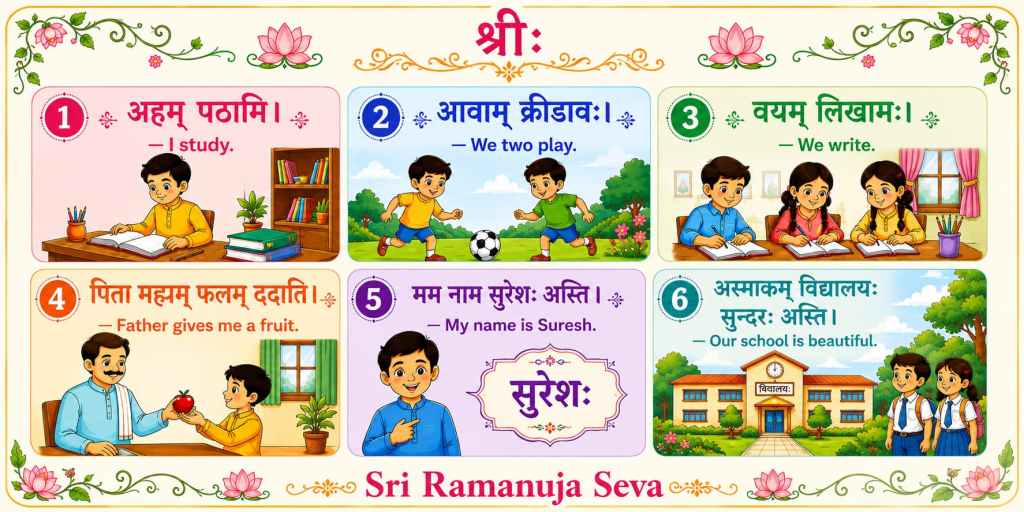
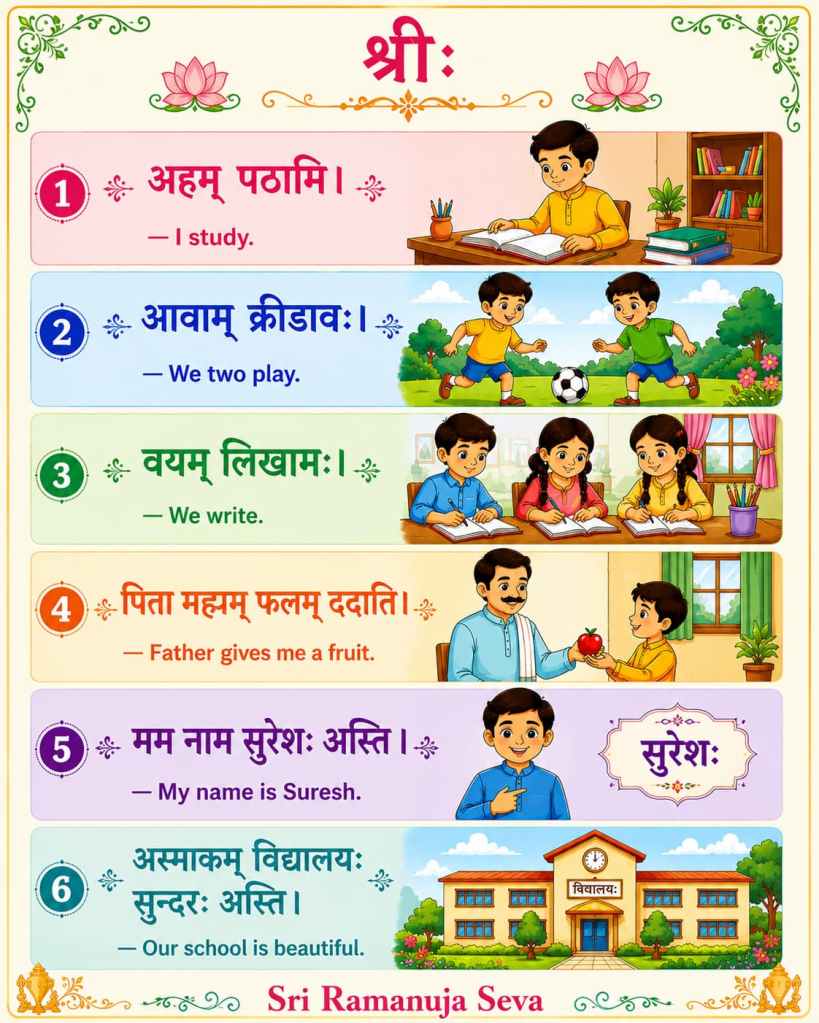
- अहम् पठामि। — I study.
- आवाम् क्रीडावः। — We two play.
- वयम् लिखामः। — We write.
- पिता मह्यम् फलम् ददाति। — Father gives me a fruit.
- मम नाम सुरेशः अस्ति । — My name is Suresh.
- अस्माकम् विद्यालयः सुन्दरः अस्ति। — Our school is beautiful.
You can see shabd roop tables of a few other words here: बालक , युष्मद्
-
In this post, we shall see:
- What is the Selection Sort algorithm? What is the basic idea behind it?
- Look at an example to see it in practice
- Analyze the running time of the algorithm
Selection Sort Algorithm
- Simple, intuitive algorithm
- Task: Sort an array of n elements in ascending (that is, non-descending) order.
- Basic idea:
- Build the sorted array element-by-element, starting from the smallest element.
- How to do that?
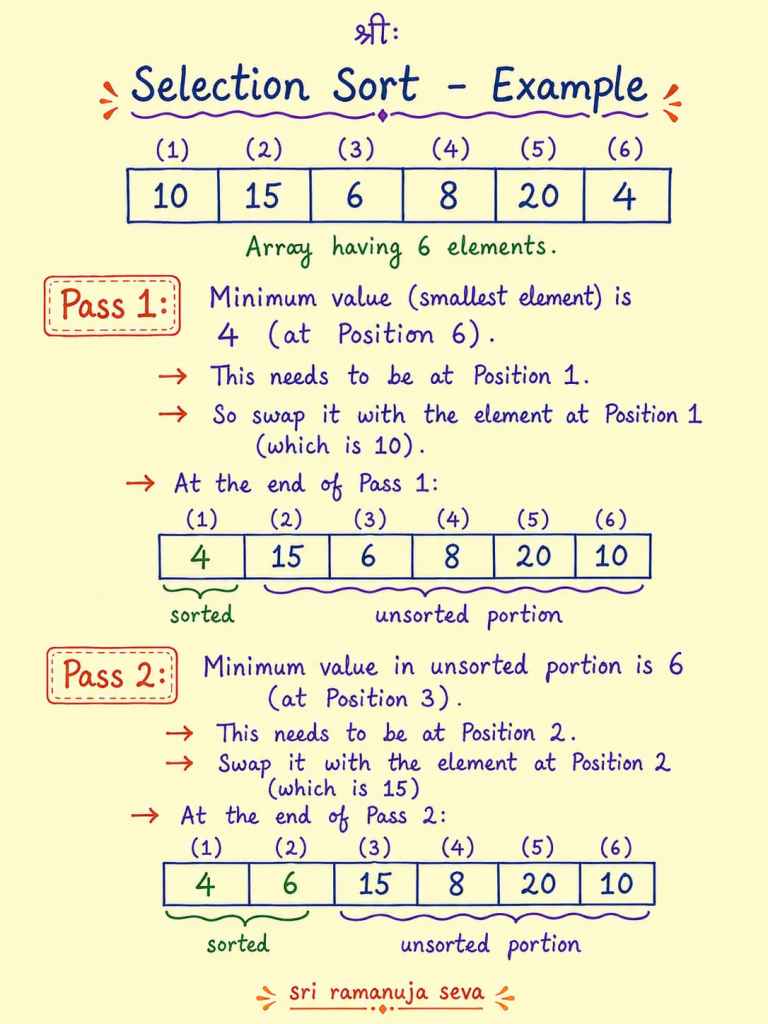
- Step 1 (or Pass 1):
- Select minimum element in the array.
- This element should be at Position 1 (since this is the smallest element in the array).
- Put it at Position 1 (that is, swap it with the element at Position 1).
- So, now, the smallest element is at Position 1, which is what we want.
- Step 2 (or Pass 2):
- Consider the subarray from Position 2 to Position n. This is unsorted. Select the smallest element in this subarray.
- This element should be at Position 2.
- Swap it with the element at Position 2.
- So, now, the 2 smallest elements of the array are at their correct positions (Positions 1 and 2). [And the remaining array, from Position 3 onwards, is still unsorted.]
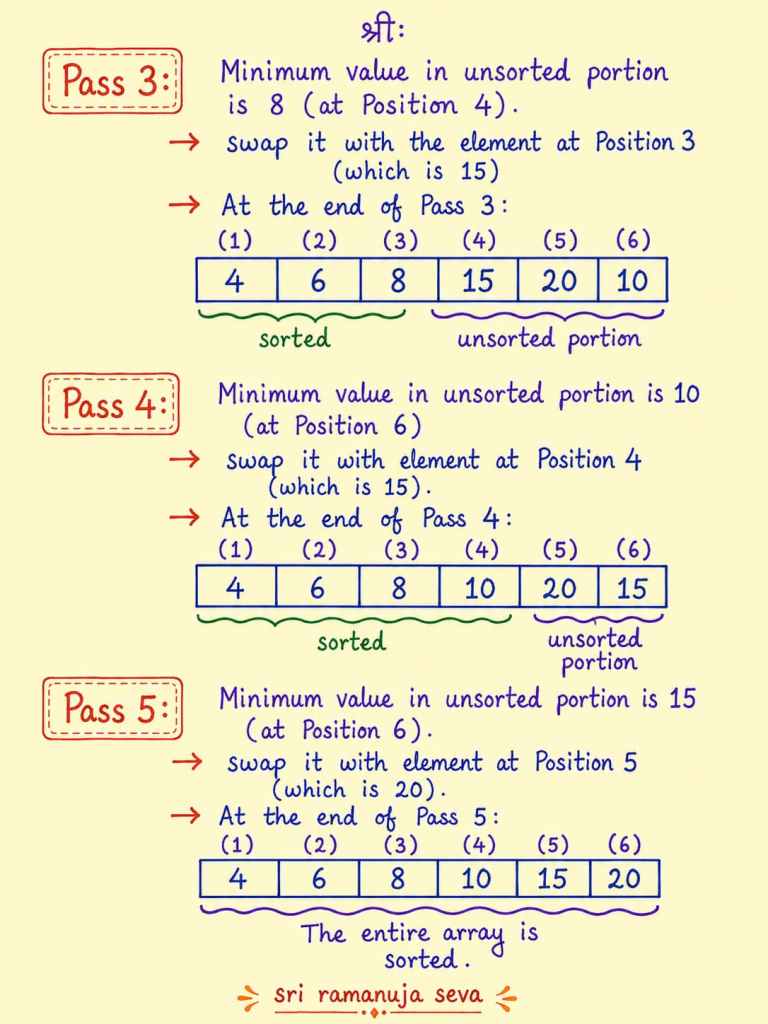
- Step 3:
- Consider the unsorted portion of the array [Position 3 to Position n].
- Select the smallest element in this subarray.
- Swap it with the element at Position 3.
- So, now, the 3 smallest elements of the array, are in their correct positions [Positions 1 through 3].
- Keep continuing this way until all n elements of the array are in their correct positions in sorted order.
- (n-1) passes will be required for this. At the end of (n-1) passes, the (n-1) smallest elements of the array would be in their correct position in sorted order, which automatically means that all n elements are sorted.
- Step 1 (or Pass 1):
What is the running time (or time complexity) of Selection Sort?
- We make (n-1) passes in all. In each pass, we find the smallest element in the unsorted portion of the array, and bring it to the beginning of the unsorted portion.
- Finding the minimum element in an array of k elements takes (k-1) comparisons.
- Bringing that element to the front of the unsorted portion (swapping it with the element at the beginning of the unsorted subarry) takes O(1) time.
- Pass 1: (n-1) comparisons [to find min element] + O(1) [for swapping]
- Pass 2: (n-2) comparisons [to find min element] + O(1) [for swapping]
- Note that the size of the unsorted subarray reduces by 1 in each pass. Hence, the number of comparisons to find the min element in the unsorted subarray also keeps reducing.
- There are (n-1) passes in all.
- Hence, total number of comparisons (over all passes) : (n-1) + (n-2) + … + 1, which is n(n-1)/2, which is O(n^2).
- Time for swapping: O(1) in each pass. Hence, over all passes, it is O(n).
- Hence, combined time for comparisons and swaps: O(n^2) + O(n), which is O(n^2).
- That is, time complexity of Selection Sort algorithm is O(n^2).
In this post, we saw:
- A short explanation of the idea behind selection sort algorithm
- Example to see it in practice
- Analyzed the time complexity of our algorithm
For other posts on algorithms, you can see here: How to find minimum value in an array.
-
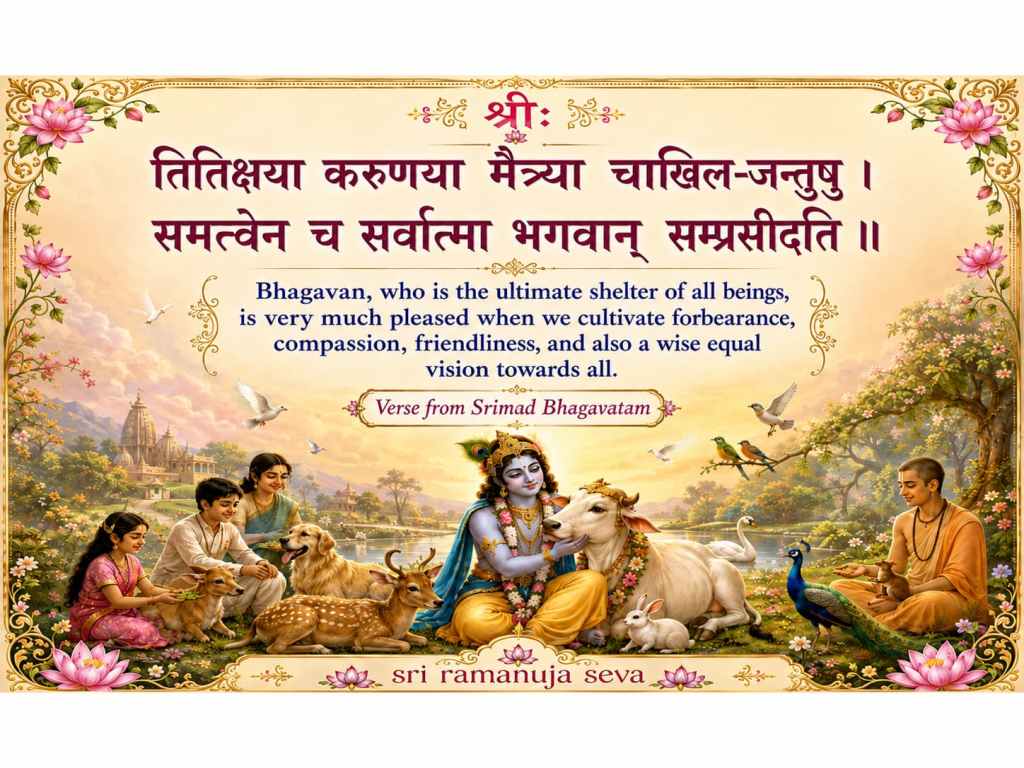
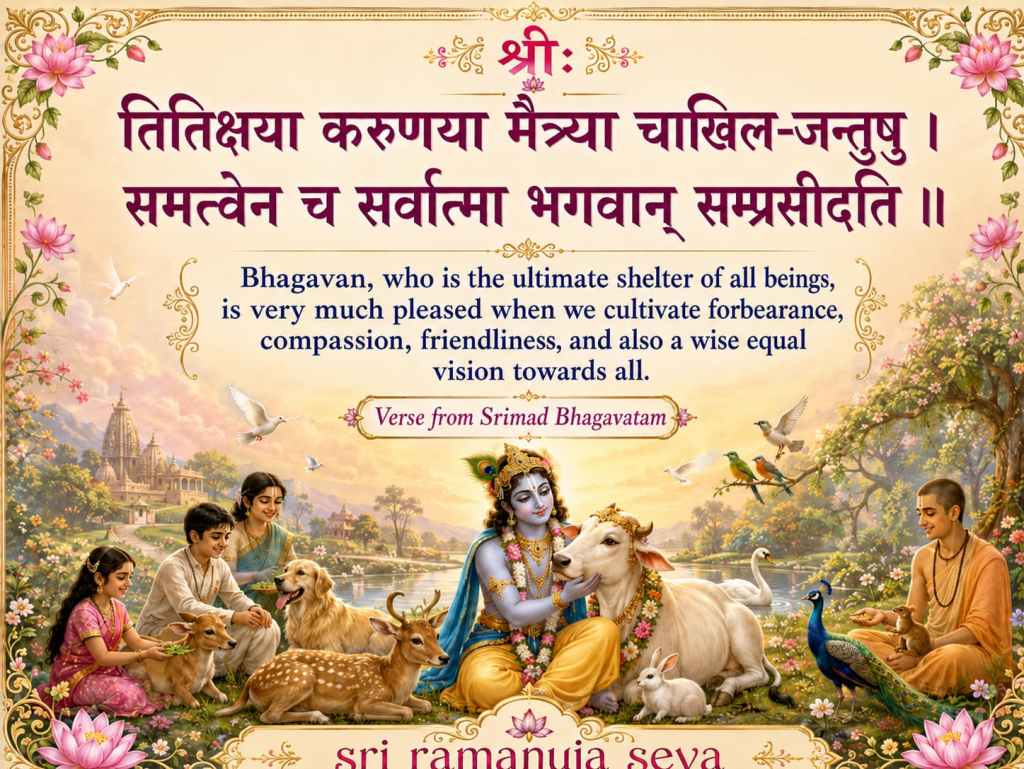
तितिक्षया करुणया मैत्र्या चाखिल-जन्तुषु ।
समत्वेन च सर्वात्मा भगवान् सम्प्रसीदति ॥
This verse appears in Srimad Bhagavatam (4th skandham). The great devotee, Dhruva became very angry towards the yakshas, and was engaged in an onslaught against them. At that time, the great authority, Swaambhuva Manu, affectionately advised him to desist from such thing, and told about qualities which make Bhagavan Sri Hari very much satisfied with us.
Qualities that a devotee should sincerely try to cultivate; qualities that greatly please Sri Bhagavan:भगवान् = The Supreme Lord Sri Hari
सर्वात्मा = paramatma, the ultimate shelter of all beings
सम्प्रसीदति = is very much pleased, very much satisfied
“The Supreme Lord Sri Hari, who is the ultimate shelter of all beings, is very much pleased and satisfied (by the following traits) “
By what is bhagavan pleased?
तितिक्षया = by tolerance / forbearance / forgiveness / patience- One should have forbearance / forgiveness even towards those who cause us trouble, or ill-treat us
करुणया = by compassion / mercy / kindness- Be compassionate towards the ignorant, innocent, and those who are less fortunate
- Even towards misguided persons, who try to harm us, instead of anger, we can have sympathy, pity, compassion towards them (that they are so ignorant and misguided).
मैत्र्या = by a friendly attitude
- Don’t have inimical attitude towards anyone. Have well-wishing nature towards all.
च = and
अखिल जन्तुषु = towards all beings
समत्वेन = feeling of equal vision, in the sense that all are part and parcel of bhagavan
“Bhagavan, who is the ultimate shelter of all beings, is very much pleased when we cultivate forbearance, compassion, friendliness, and also a wise equal vision towards all.”
Take-away message from this verse-
There will be those who ill-treat us, mistreat us, insult us, or cause us trouble, or try to harm us in various ways. For our own benefit, we should not get unduly agitated, or disturbed, by such things.
We can take that such persons are also acting governed by Sri Bhagavan, who is always our well-wisher. We can also take that we are only getting some reactions to our own past karma. Hence, no need to develop undue anger towards such persons, or to have vengeful attitude towards them, or to become inimical towards them.
Further, we can consider that we have better things to focus on than the behaviour of such persons, and hence need not lose our peace or composure thinking about such persons. Just as a stray barking dog on the street is not taken seriously by us (we don’t develop inimical attitude towards it, knowing that it is just it’s nature), similarly we should learn to avoid getting unduly agitated by inimical persons.And generally, towards all beings, including the misguided ones, we can have a well-wishing attitude.
And towards those who are innocent-natured or less fortunate, we can show compassion, and help to uplift them.
Similar posts from Srimad Bhagavatam: Formula for happy life taught by Naradar
-
In this post, we have:
- few sentences about Sri Rama.
- Grammatical analysis of a couple of them
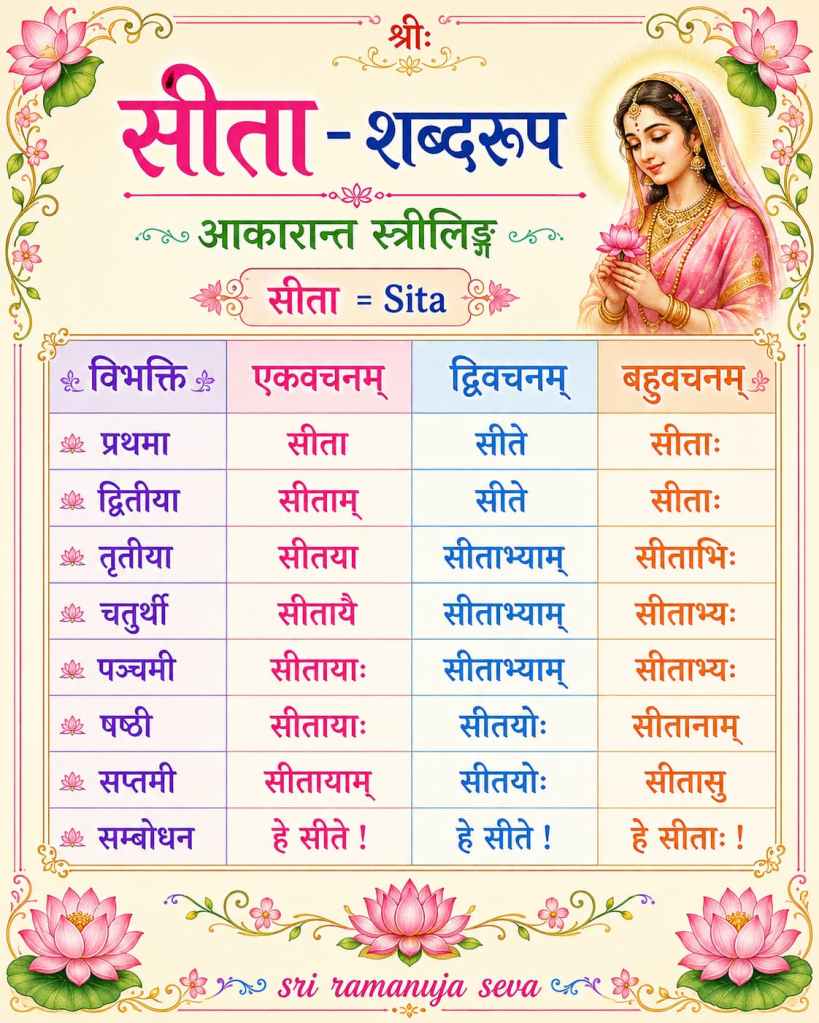
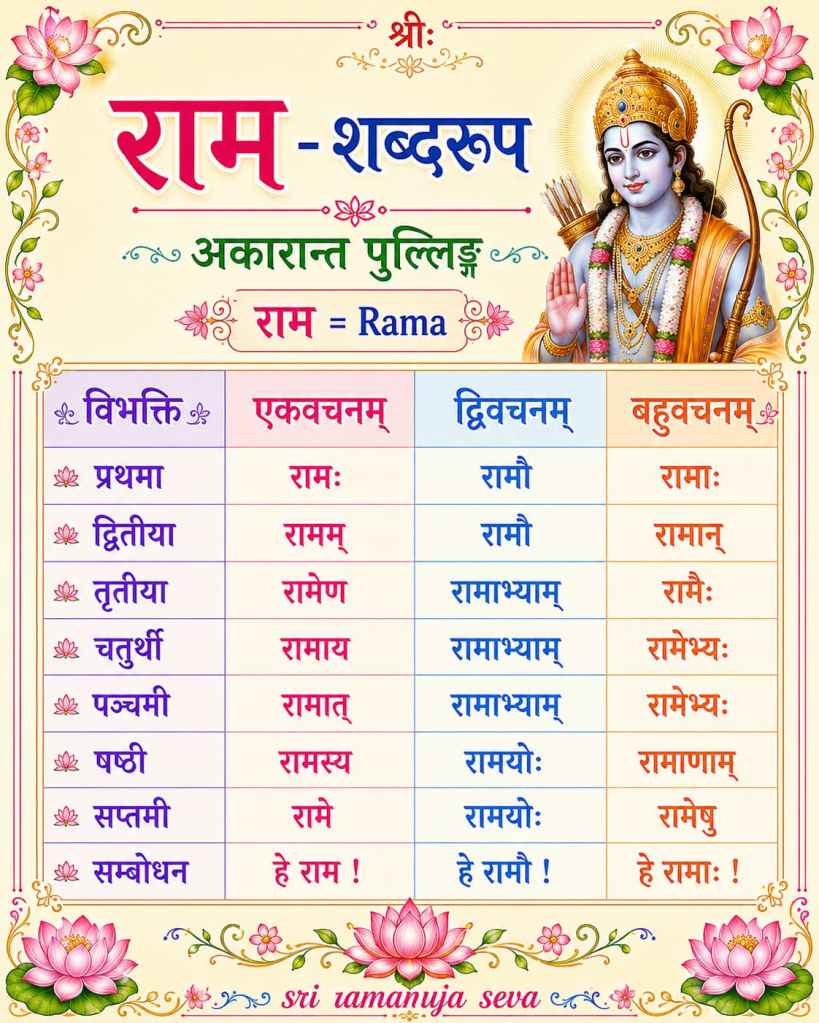
- शब्दरूप tables for सीता and राम
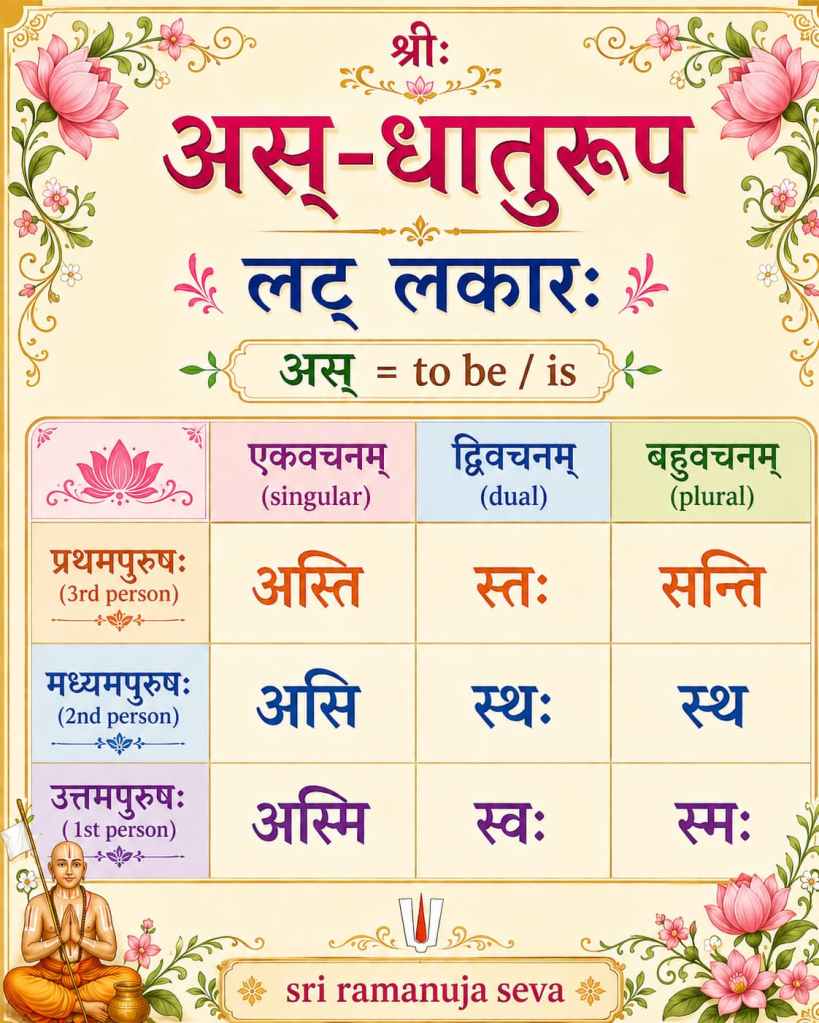
- धातुरूप table for अस् धातु in present tense
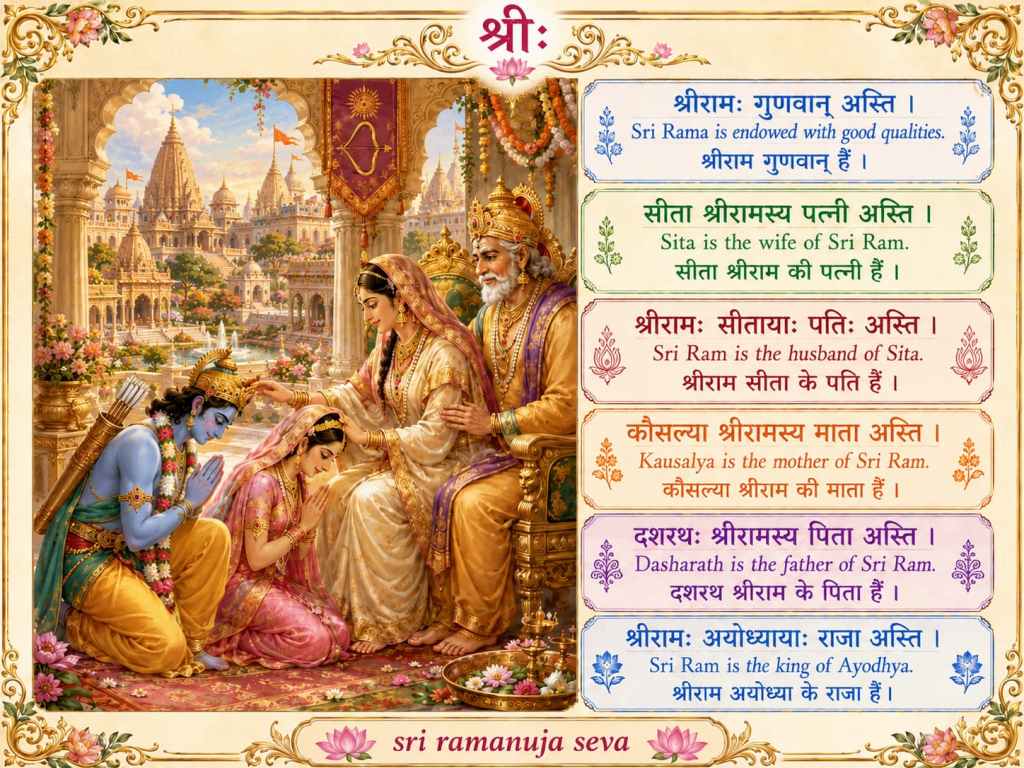
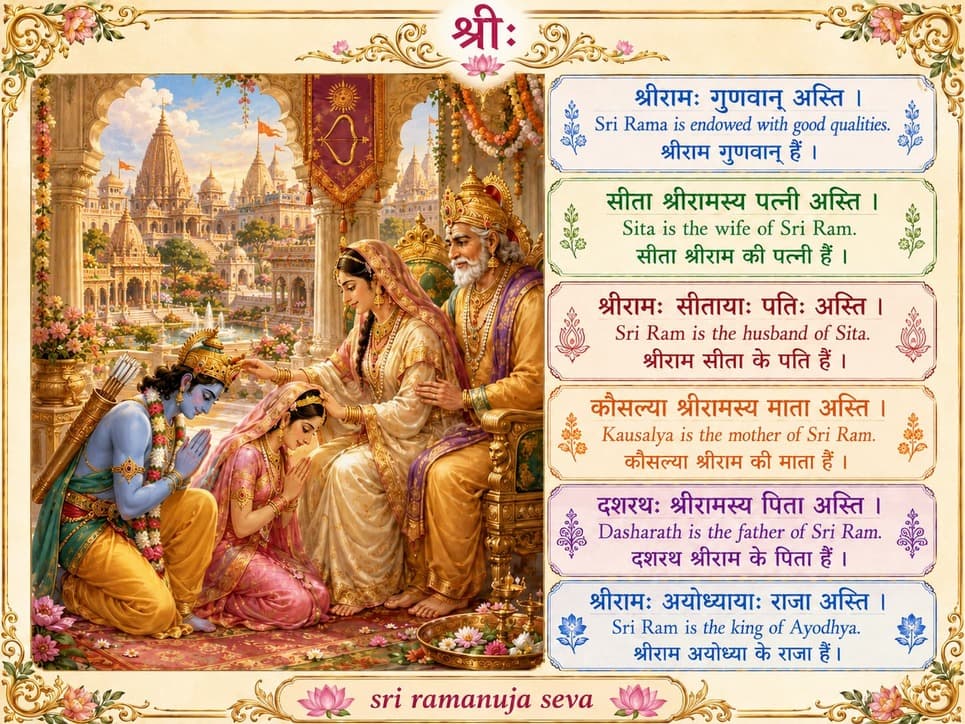
श्रीरामः गुणवान् अस्ति । Sri Rama is endowed with good qualities. श्रीराम गुणवान् हैं ।
सीता श्रीरामस्य पत्नी अस्ति । Sita is the wife of Sri Ram. सीता श्रीराम की पत्नी हैं ।
श्रीरामः सीतायाः पतिः अस्ति । Sri Ram is the husband of Sita. श्रीराम सीता के पति हैं ।
कौसल्या श्रीरामस्य माता अस्ति । Kausalya is the mother of Sri Ram. कौसल्या श्रीराम की माता हैं ।
दशरथः श्रीरामस्य पिता अस्ति । Dasharath is the father of Sri Ram. दशरथ श्रीराम के पिता हैं ।
श्रीरामः अयोध्यायाः राजा अस्ति । Sri Ram is the king of Ayodhya. श्रीराम अयोध्या के राजा हैं।
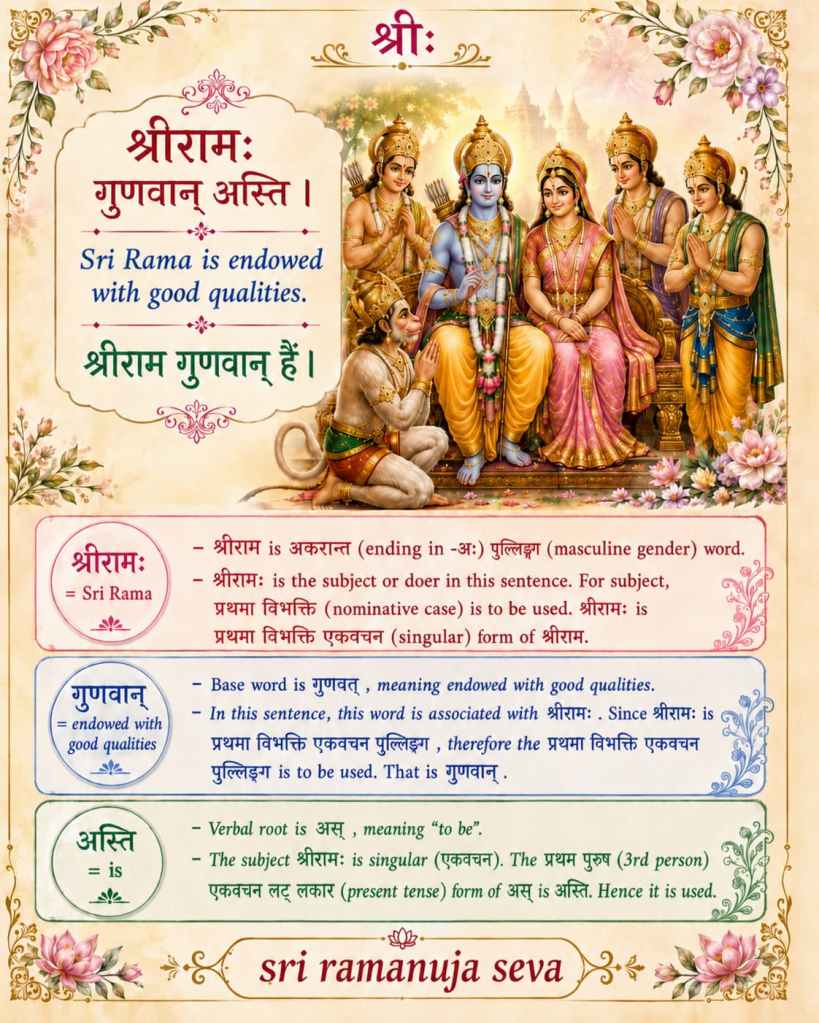
श्रीरामः गुणवान् अस्ति । Sri Rama is endowed with good qualities. श्रीराम गुणवान् हैं ।
- श्रीरामः = Sri Rama
- श्रीराम is अकारान्त (ending in -अ) पुल्लिङ्ग (masculine gender) word. श्रीराम is the subject or doer in this sentence. For subject, प्रथमा विभक्ति (nominative case) is to be used. श्रीरामः is प्रथमा विभक्ति एकवचन (singular) form of श्रीराम.
- गुणवान् = endowed with good qualities
- Base word is गुणवत् , meaning endowed with good qualities.
- In this sentence, this word is associated with श्रीरामः . Since श्रीरामः is प्रथमा विभक्ति एकवचन पुंल्लिङ्ग , therefore the प्रथमा विभक्ति एकवचन पुंल्लिङ्ग is to be used. That is गुणवान् .
- अस्ति = is
- Verbal root is अस् , meaning “to be”.
- The subject श्रीरामः is singular (एकवचन). The प्रथम पुरुष (3rd person) एकवचन लट् लकार (present tense) form of अस् is अस्ति. Hence it is used.
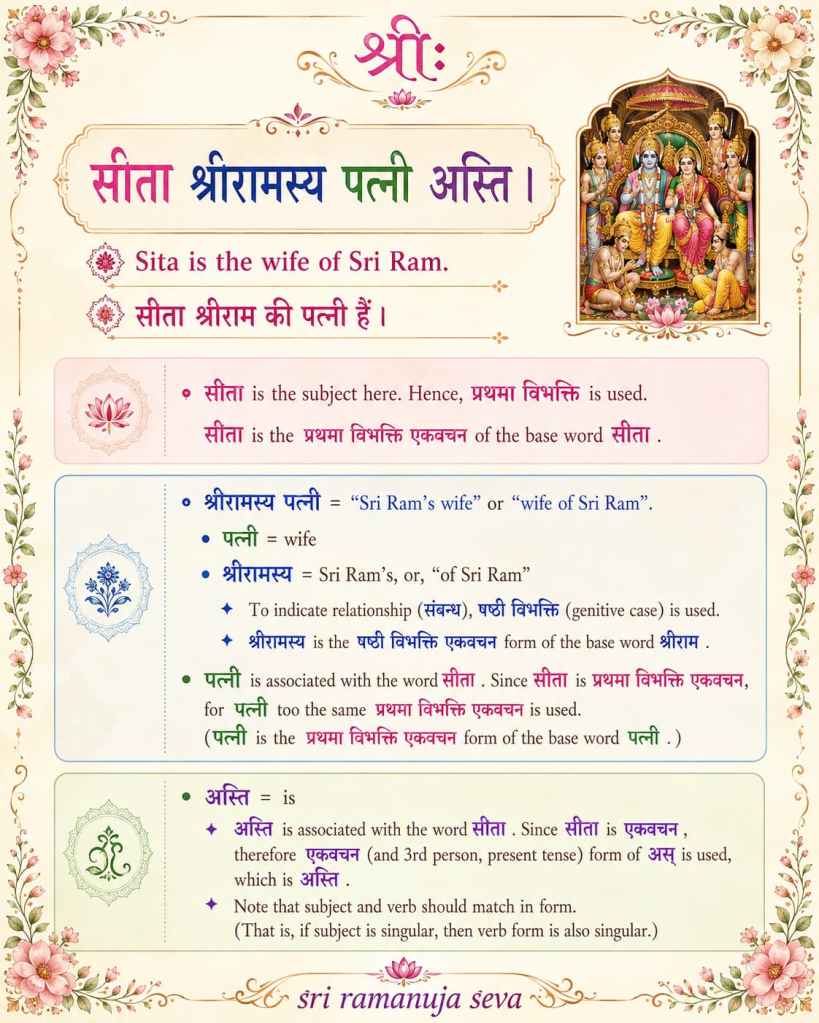
सीता श्रीरामस्य पत्नी अस्ति । Sita is the wife of Sri Ram. सीता श्रीराम की पत्नी हैं ।
- सीता is the subject here. Hence, प्रथमा विभक्ति is used. सीता is the प्रथमा विभक्ति एकवचन of the base word सीता .
- श्रीरामस्य पत्नी = “Sri Ram’s wife” or “wife of Sri Ram”.
- पत्नी = wife
- श्रीरामस्य = Sri Ram’s, or, “of Sri Ram”
- To indicate relationship (संबन्ध), षष्ठी विभक्ति (genitive case) is used.
- श्रीरामस्य is the षष्ठी विभक्ति एकवचन form of the base word श्रीराम .
- पत्नी is associated with the word सीता . Since सीता is प्रथमा विभक्ति एकवचन, for पत्नी too the same प्रथमा विभक्ति एकवचन is used. (पत्नी is the प्रथमा विभक्ति एकवचन form of the base word पत्नी .)
- अस्ति = is
- अस्ति is associated with the word सीता . Since सीता is एकवचन , therefore एकवचन (and 3rd person, present tense) form of अस् is used, which is अस्ति .
- Note that subject and verb should match in form. (That is, if subject is singular, then verb form is also singular.)
सीता-शब्दरूप
आकारान्त स्त्रीलिङ्ग
सीता = Sitaविभक्ति एकवचनम् द्विवचनम् बहुवचनम् प्रथमा सीता सीते सीताः द्वितीया सीताम् सीते सीताः तृतीया सीतया सीताभ्याम् सीताभिः चतुर्थी सीतायै सीताभ्याम् सीताभ्यः पञ्चमी सीतायाः सीताभ्याम् सीताभ्यः षष्ठी सीतायाः सीतयोः सीतानाम् सप्तमी सीतायाम् सीतयोः सीतासु सम्बोधन हे सीते ! हे सीते ! हे सीताः ! राम-शब्दरूप
अकारान्त पुंल्लिङ्ग
राम = Ramaविभक्ति एकवचनम् द्विवचनम् बहुवचनम् प्रथमा रामः रामौ रामाः द्वितीया रामम् रामौ रामान् तृतीया रामेण रामाभ्याम् रामैः चतुर्थी रामाय रामाभ्याम् रामेभ्यः पञ्चमी रामात् रामाभ्याम् रामेभ्यः षष्ठी रामस्य रामयोः रामाणाम् सप्तमी रामे रामयोः रामेषु सम्बोधन हे राम ! हे रामौ ! हे रामाः !
अस्-धातुरूप
लट् लकारः — Present Tense
अस् = to beपुरुषः एकवचनम् (Singular) द्विवचनम् (Dual) बहुवचनम् (Plural) प्रथमपुरुषः (3rd person) अस्ति स्तः सन्ति मध्यमपुरुषः (2nd person) असि स्थः स्थ उत्तमपुरुषः (1st person) अस्मि स्वः स्मः Meanings
- अस्ति = he/she/it is
- स्तः = they two are
- सन्ति = they are
- असि = you are
- स्थः = you two are
- स्थ = you (more than two) are
- अस्मि = I am
- स्वः = we two are
- स्मः = we (more than two) are
For more similar posts, you can see here: Simple sentences about school
 sri ramanuja seva