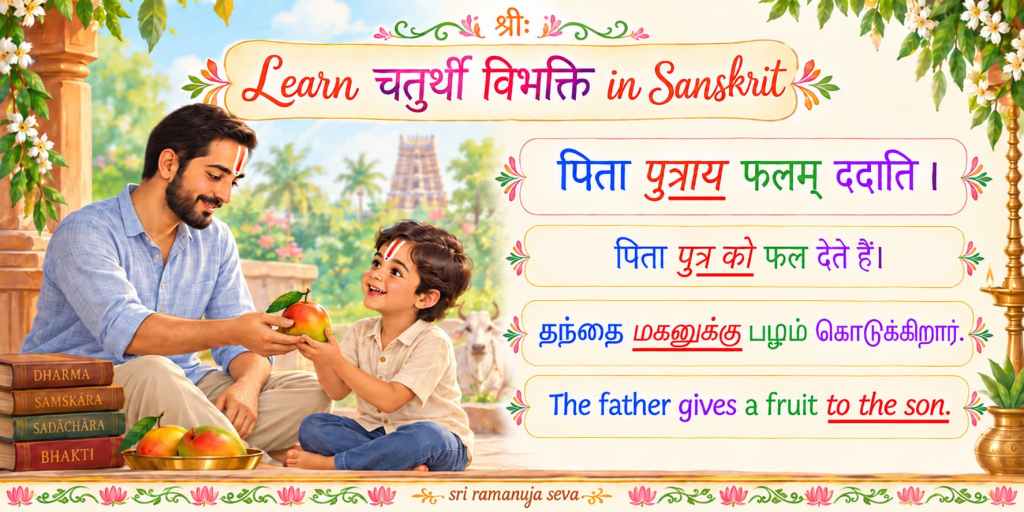
चतुर्थी विभक्ति is used in the sense of “to someone” or “for someone”. Two common examples are when we give something to someone, or when we offer namaskarams to someone. चतुर्थी विभक्ति is used for the recipient.
We’ll look at a few examples.
पिता पुत्राय फलम् ददाति ।
- Hindi- पिता पुत्र को फल देते हैं।
- Tamil- தந்தை மகனுக்கு பழம் கொடுக்கிறார்.
- English: The father gives a fruit to the son.
पुत्राय is चतुर्थी विभक्ति . Means “to the son”.
To whom does father give the fruit?
Answer: To the son.
पुत्राय is the चतुर्थी विभक्ति एकवचन (singular) form of पुत्र .
(If father gave fruit to many sons, we would use पुत्रेभ्यः , which is चतुर्थी विभक्ति बहुवचन (plural) form of पुत्र )
Who gives the fruit?
Answer. The father gives the fruit.
Father is the subject (the doer, the performer of the action) in the sentence. प्रथमा विभक्ति is used for the subject.
पिता is the प्रथमा विभक्ति एकवचन form of पितृ.
What is the action or verb here?
Answer: “giving”
The subject and verb forms must match.
Since the subject पिता is एकवचन , the एकवचन form of the verb for giving is used.
ददाति is the लट् लकार (present tense) प्रथमपुरुष (3rd person) एकवचन (singular) form of दा धातु (the verb for giving).
What does the father give?
Answer: a fruit
The action is “giving”. The subject is the father. And the action is performed upon the fruit. The fruit is the object in the sentence.
द्वितीया विभक्ति is used for the object in a sentence.
(You can see this post to review प्रथमा विभक्ति and द्वितीया विभक्ति .)
फलम् is the द्वितीया विभक्ति एकवचन form of फल .
Combining the terms above, we get the sentence: पिता पुत्राय फलम् ददाति ।
We’ll look at more examples:
माता बालिकायै भोजनम् ददाति।
Hindi: माता लड़की को भोजन देती हैं।
Tamil: தாய் சிறுமிக்கு உணவு கொடுக்கிறார்.
English: The mother gives food to the girl.
माता (mother) : Subject (performer of action). Therefore, प्रथमा विभक्ति is used.
- माता is प्रथमा विभक्ति एकवचन form of मातृ (the base word for mother).
बालिकायै (to the girl) : the recipient . Therefore, चतुर्थी विभक्ति is used.
- बालिकायै is चतुर्थी विभक्ति एकवचन form of बालिका (the base word for girl).
- (shabd roop forms of बालिका are given in this post.)
भोजनम् (food): This is the object in the sentence. Therefore, द्वितीया विभक्ति is used.
- भोजनम् is द्वितीया विभक्ति एकवचन form of भोजन (the base word for food).
ददाति (gives): This is action or verb in the sentence. Its form corresponds to the form of the subject (माता ).
- माता is एकवचन . Similarly, ददाति is the 3rd person एकवचन form in present tense of दा धातु (the verb for giving).
शिक्षकः छात्रेभ्यः पुस्तकम् ददाति।
शिक्षक छात्रों को पुस्तक देते हैं।
ஆசிரியர் மாணவர்களுக்கு புத்தகம் கொடுக்கிறார்.
The teacher gives a book to the students.
छात्रेभ्यः is चतुर्थी विभक्ति बहुवचन (plural) form of छात्र (the base word for student). Means, “to the students”.
For similar posts, you may see here: Learn तृतीया विभक्ति examples.
 sri ramanuja seva
Leave a comment