तृतीया विभक्तिः is commonly used with सह , which means “with” or “along with”. We’ll look at a few examples below.
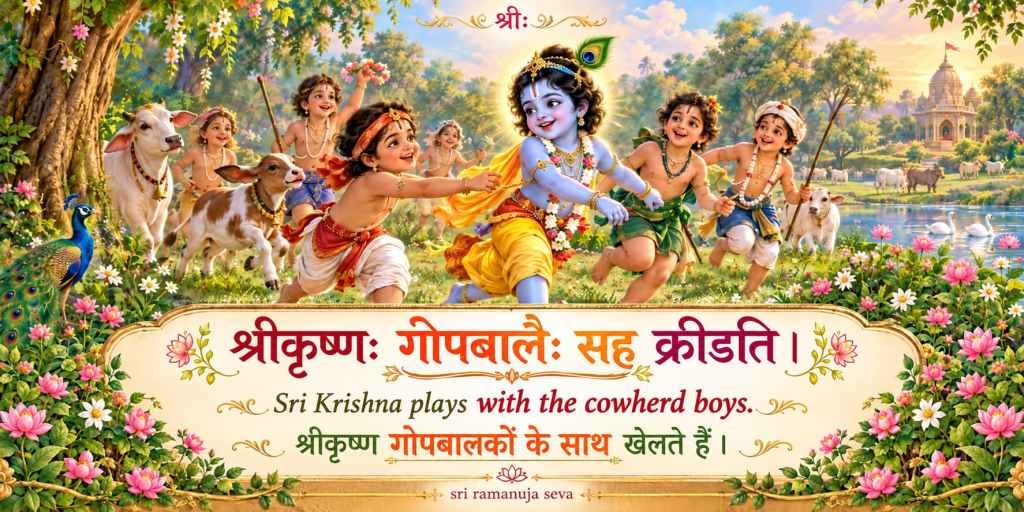
1. श्रीकृष्णः गोपबालैः सह क्रीडति।
- Sri Krishna plays with the cowherd boys.
- श्रीकृष्ण गोपबालकों के साथ खेलते हैं ।
- गोपबालैः सह means “with the cowherd boys”.
- The base word is गोपबाल. The तृतीया विभक्तिः बहुवचनम् (plural) form of गोपबाल is गोपबालैः .
- The शब्दरूपम् forms of गोपबाल are similar to बालक. (Shabd roop of बालक is given here.) Just as तृतीया विभक्तिः बहुवचनम् form of बालक is बालकैः, similarly the form of गोपबाल is गोपबालैः .
2. गोपबालाः श्रीकृष्णेन सह क्रीडन्ति ।
- The cowherd boys play with Sri Krishna.
- गोपबालक श्रीकृष्ण के साथ खेलते हैं ।
- श्रीकृष्णेन सह means “with Sri Krishna”
- श्रीकृष्णेन is the तृतीया विभक्तिः एकवचनम् (singular) form of श्रीकृष्ण .
3. श्रीरामः सीतया सह गच्छति।
- Sri Ram goes with Sita.
- श्रीराम सीता के साथ जाते हैं ।
- सीतया is the तृतीया विभक्तिः एकवचनम् form of सीता . (Shabd roop of सीता is given here. )
4. लक्ष्मणः सीतारामाभ्याम् सह गच्छति।
- Lakshman goes with Sita-Ram.
- लक्ष्मण सीता-राम के साथ जाते हैं ।
- सीतारामाभ्याम् is the तृतीया विभक्तिः द्विवचनम् (dual) form of सीताराम .
5. पिता पुत्रेण सह क्रीडति।
- The father plays with the son.
- पिता पुत्र के साथ खेलते हैं ।
- पुत्रेण is the तृतीया विभक्तिः एकवचनम् form of पुत्र .
6. बालकः मात्रा सह खादति।
- The boy eats with the mother.
- लडका माता के साथ खाता है ।
- मात्रा is the तृतीया विभक्तिः एकवचनम् form of मातृ .
Above we saw examples of a few simple sentences where तृतीया विभक्तिः forms have been used. Specifically, we saw the तृतीया विभक्तिः forms are used along with सह , which means “with” or “along with”.
Similar posts: प्रथमा विभक्तिः examples
 sri ramanuja seva
Leave a comment