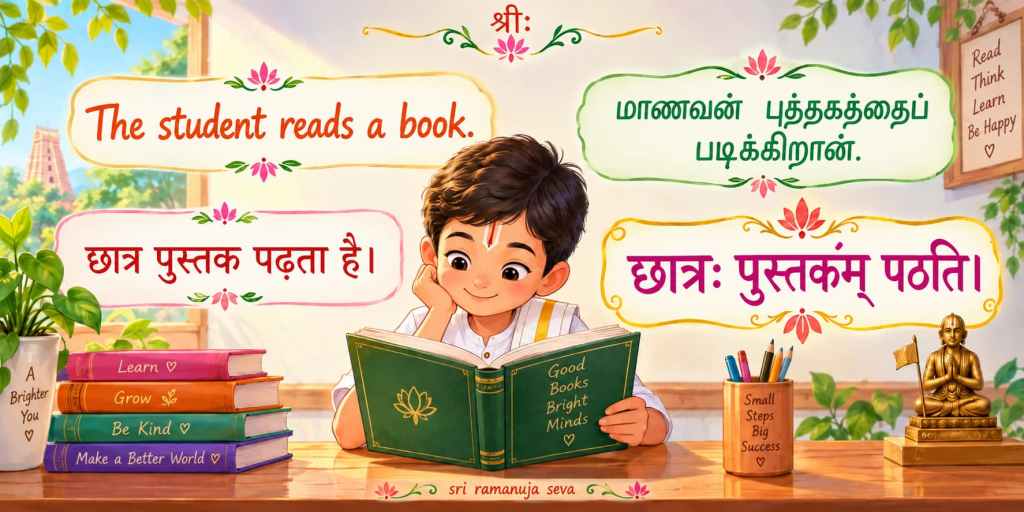
In this post, we shall look at the construction of a couple of simple sentences in Sanskrit, illustrating the use of प्रथमा विभक्ति and द्वितीया विभक्ति .
छात्रः पुस्तकम् पठति।
(The student reads a book.)
छात्रः (student) is the subject. (The person doing the action)
- प्रथमा विभक्ति is used for the subject. छात्रः is the प्रथमा विभक्ति एकवचन form of छात्र .
What is the action?
पठति (reads) is the action.
- The form of the verb matches the form of the subject. That is, since the subject is singular (एकवचन ), the singular form the verb (for reading) is used.
- पठति is the प्रथमपुरुष (3rd person) एकवचन (singular) लट् लकार (present tense) form of पठ् धातु (the verb for reading / studying.)
छात्रः पठति। means “The student reads.”
Now, we introduce an object in the sentence.
What does the student read?
The student reads a book.
“A book” is the object.
छात्रः पुस्तकम् पठति।
- द्वितीया विभक्ति is used for the object.
- पुस्तकम् (book) is the object in the sentence.
- पुस्तकम् is the द्वितीया विभक्ति एकवचन form of पुस्तक .
In English, the order of terms in a sentence is – Subject – Verb – Object.
- For example, “The student reads a book.”
- Here, Subject is “The student”
- Verb is “reads” .
- Object is “a book”.
In languages like Sanskrit, Hindi, Tamil, the order is: Subject – Object – Verb.
- छात्रः पुस्तकम् पठति।
- Subject (the person doing the action) is छात्रः .
- Object (the thing upon which the action is done) is पुस्तकम् .
- Verb (the action being performed) is पठति .
- Hindi: छात्र पुस्तक पढ़ता है।
- Subject (the person doing the action) is छात्र
- Object (the thing upon which the action is done) is पुस्तक
- Verb (the action being performed) is पढ़ता है
- Tamil: மாணவன் புத்தகத்தைப் படிக்கிறான் .
- Subject is மாணவன்
- Object is புத்தகத்தைப்
- Verb is படிக்கிறான்
बालकः फलम् खादति।
- English: The boy eats a fruit.
- Hindi: लड़का फल खाता है।
- Tamil: சிறுவன் பழத்தைச் சாப்பிடுகிறான்.
Subject (person performing the action) is बालकः .
Verb (the action being performed) is खादति .
Who eats? The boy eats.
- Therefore, “The boy” is the subject.
- प्रथमा विभक्ति is used for subject.
- बालकः is the प्रथमा विभक्ति एकवचन form of बालक .
What does the boy do? He eats.
- “eats” is the verb.
- The forms of the subject and verb should match.
- बालकः is एकवचन (singular) . Therefore, the एकवचन form of the verb for eating is used.
- खादति is the प्रथमपुरुष (3rd person) एकवचन form खाद् धातु (the verb for eating).
We saw the Subject and Verb above. Now, we introduce the Object.
What does the boy eat? Fruit.
बालकः फलम् खादति।
- The object is the thing upon which the action is performed.
- द्वितीया विभक्ति is used for the object.
- फलम् is the द्वितीया विभक्ति एकवचन form of फल .
In this post, we looked at a couple of examples to understand the construction of simple sentences in Sanskrit. We looked at simple examples of प्रथमा विभक्ति and द्वितीया विभक्ति .
Related posts: तृतीया विभक्ति examples , Learn चतुर्थी विभक्ति
 sri ramanuja seva
Leave a comment