Wise sayings in Sanskrit – 2. Effort leads to accomplishment.
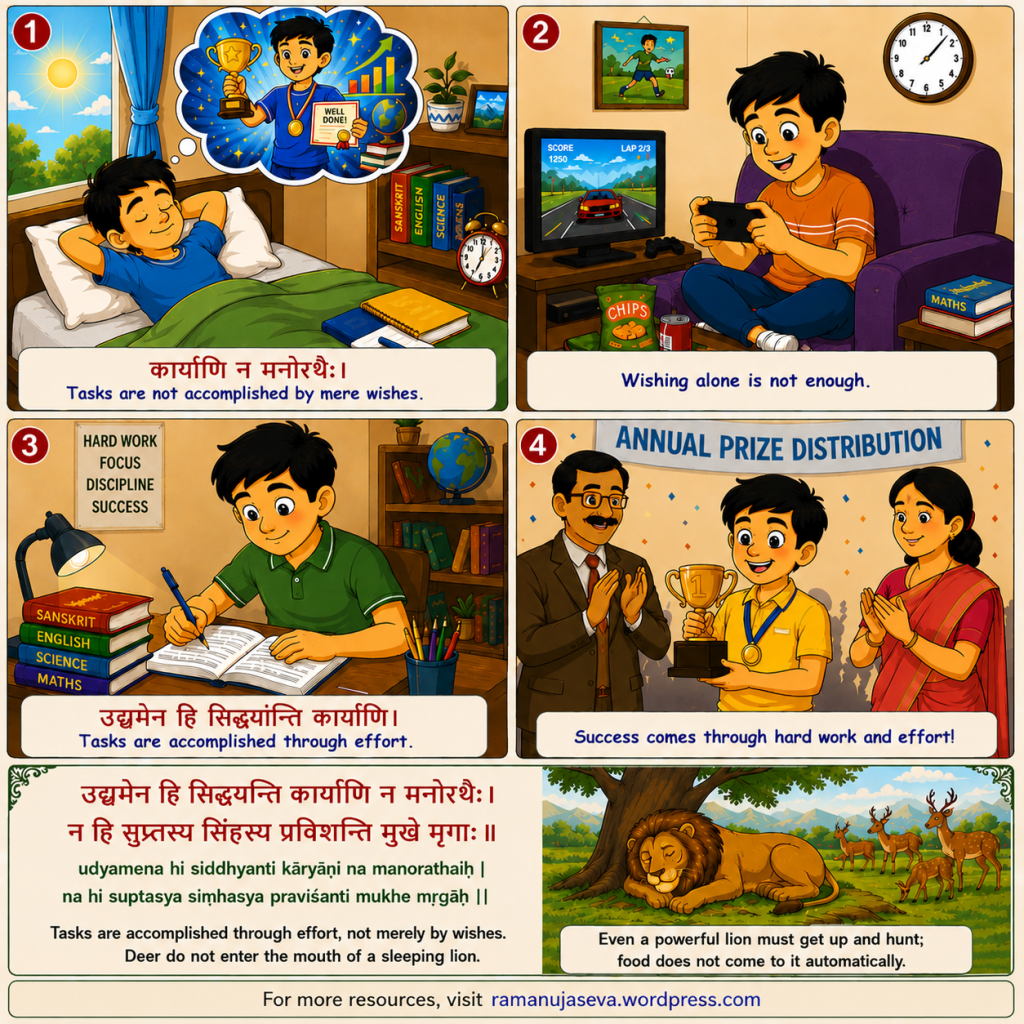
उद्यमेन हि सिद्ध्यन्ति कार्याणि न मनोरथैः ।
न हि सुप्तस्य सिंहस्य प्रविशन्ति मुखे मृगाः ॥
udyamena hi siddhyanti kāryāṇi na manorathaiḥ ।
na hi suptasya siṃhasya praviśanti mukhe mṛgāḥ ॥
Tasks are accomplished through effort, not merely by wishes. Deer do not enter the mouth of a sleeping lion.
Word-by-Word Meaning (with grammar notes)
First Line
कार्याणि — tasks, works (कार्य , नपुंसकलिङ्गम् — प्रथमा-विभक्तिः — बहुवचनम् ) (neuter, nominative, plural) सिद्ध्यन्ति — are accomplished (प्रथम-पुरुषः, बहुवचनम्) (third person, plural)
उद्यमेन — by effort (उद्यम , पुल्लिङ्गम् , तृतीया-विभक्तिः, एकवचनम्) (masculine, instrumental, singular)
हि — indeed (अव्ययम्) (indeclinable)
न — not (अव्ययम्) (indeclinable)
मनोरथैः — by wishes, daydreams (मनोरथ — पुल्लिङ्गम् — तृतीया-विभक्तिः — बहुवचनम् ) (masculine, instrumental, plural)
Second Line
मृगाः — deer (मृग — पुल्लिङ्गम् — प्रथमा-विभक्तिः — बहुवचनम्) (masculine, nominative, plural)
हि — indeed (अव्ययम्) (indeclinable)
न — not (अव्ययम्) (indeclinable)
प्रविशन्ति — enter (प्र + विश् — लट्-लकारः — प्रथम-पुरुषः — बहुवचनम् ) (present tense, third person, plural)
मुखे — into the mouth (मुख — नपुंसकलिङ्गम् — सप्तमी-विभक्तिः — एकवचनम् ) (neuter, locative, singular)
सुप्तस्य — of a sleeping (सुप्त — पुल्लिङ्गम् — षष्ठी-विभक्तिः — एकवचनम् ) (masculine, genitive, singular)
सिंहस्य — of a lion (सिंह — पुल्लिङ्गम् — षष्ठी-विभक्तिः — एकवचनम्) (masculine, genitive, singular)
Simple Grammar Notes
1. Instrumental Case (तृतीया-विभक्तिः)
Notice these words:
- उद्यमेन = by effort
- मनोरथैः = by wishes
These words answer the question “By what?”
Examples:
- उद्यमेन = by effort
- पुस्तकेन = by means of a book
- हस्तेन = by hand
- उद्यमेन कार्याणि सिद्ध्यन्ति। = Tasks are accomplished through effort.
- मनोरथैः कार्याणि न सिद्ध्यन्ति। = Tasks are not accomplished by wishes.
We can see the shabd roop (case declensions) for instrumental case:
बालक (पुल्लिङ्गम्) — तृतीया-विभक्तिः:
बालकेन (एकवचनम्) | बालकाभ्याम् (द्विवचनम्) | बालकैः (बहुवचनम्)
उद्यमः (पुल्लिङ्गम्) — तृतीया-विभक्तिः:
उद्यमेन (एकवचनम्) | उद्यमाभ्याम् (द्विवचनम्) | उद्यमैः (बहुवचनम्)
मनोरथः (पुल्लिङ्गम्) — तृतीया-विभक्तिः:
मनोरथेन (एकवचनम्) | मनोरथाभ्याम् (द्विवचनम्) | मनोरथैः (बहुवचनम्)
2. Genitive Case (षष्ठी-विभक्तिः)
Notice:
- सुप्तस्य = of a sleeping
- सिंहस्य = of a lion
Together:
सुप्तस्य सिंहस्य = of a sleeping lion
3. Adjective-Noun agreement
सुप्तस्य सिंहस्य = of a sleeping lion (षष्ठी-विभक्तिः — एकवचनम्) (genitive, singular)
सुप्तेन सिंहेन = by a sleeping lion (तृतीया-विभक्तिः — एकवचनम्) (instrumental, singular)
सुप्तः सिंहः = a sleeping lion (प्रथमा-विभक्तिः , एकवचनम् ) (nominative, singular)
4. Verb
सिद्ध्यन्ति = are accomplished
प्रविशन्ति = enter
The ending -न्ति often indicates that the subject is plural.
Examples:
- मृगाः प्रविशन्ति। — The deer enter.
- छात्राः पठन्ति। — The students study.
Vocabulary Practice
- उद्यमः — effort
- कार्यम् — task, work
- मनोरथः — wish, desire
- सिंहः — lion
- मृगः — deer
- मुखम् — mouth
What Does the Verse Teach?
The verse teaches that success comes through effort. Merely wishing for success is not enough. Even a powerful lion must get up and act; food does not come to it automatically.
उद्यमः आवश्यकः।
Effort is necessary.
उद्यमेन सफलता भवति।
Success comes through effort.
शुभमस्तु!
 sri ramanuja seva
Leave a comment