Questions and Answers, for CS 3251 – Programming in C. Part 6.
(For Part 5 of this series, pls see here: 16 marks Q & A on Loops (Unit 1). )
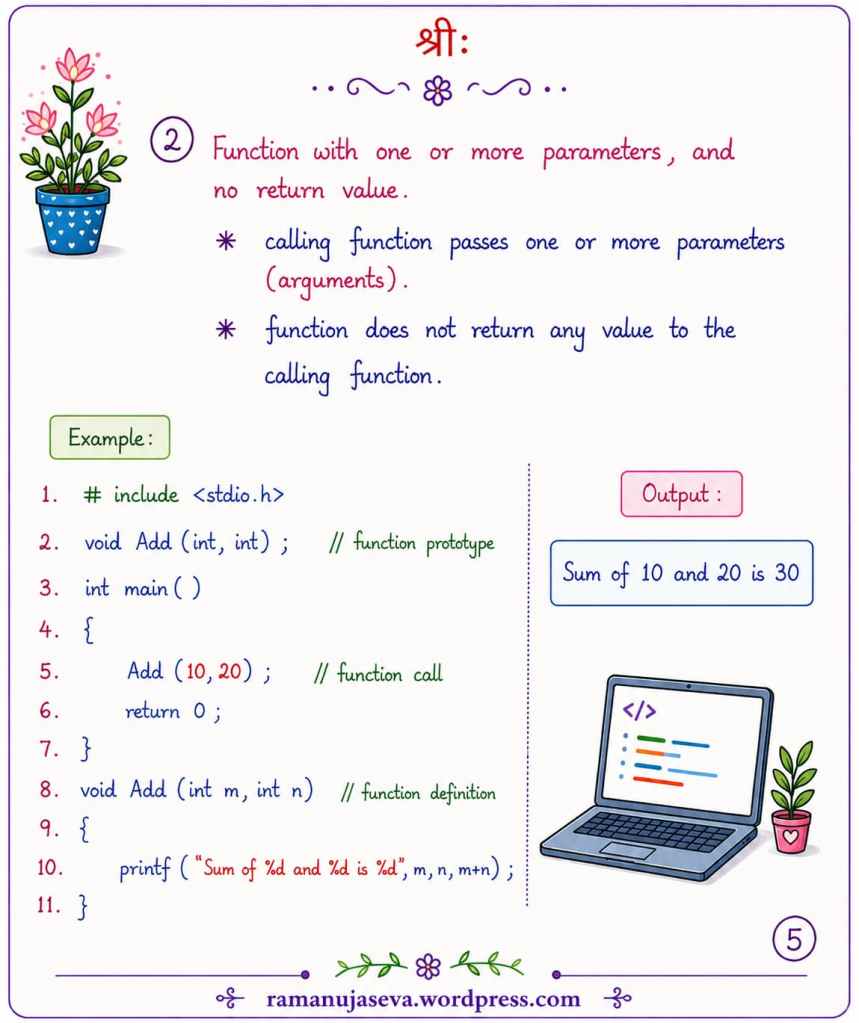
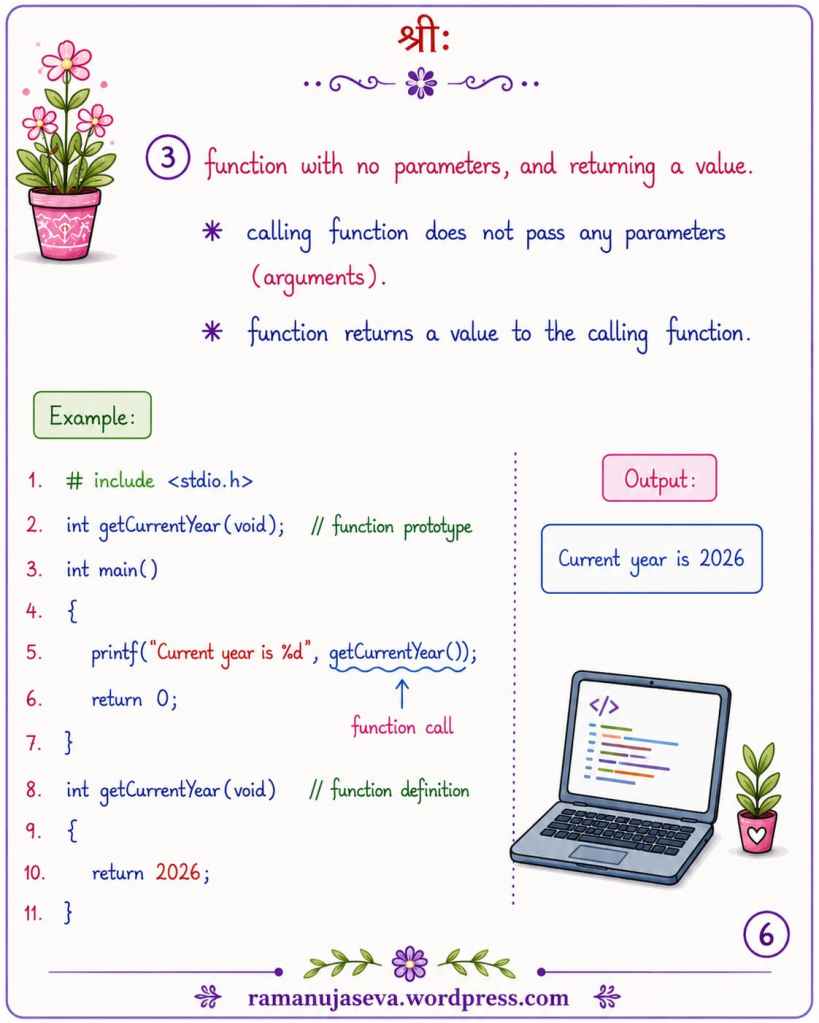

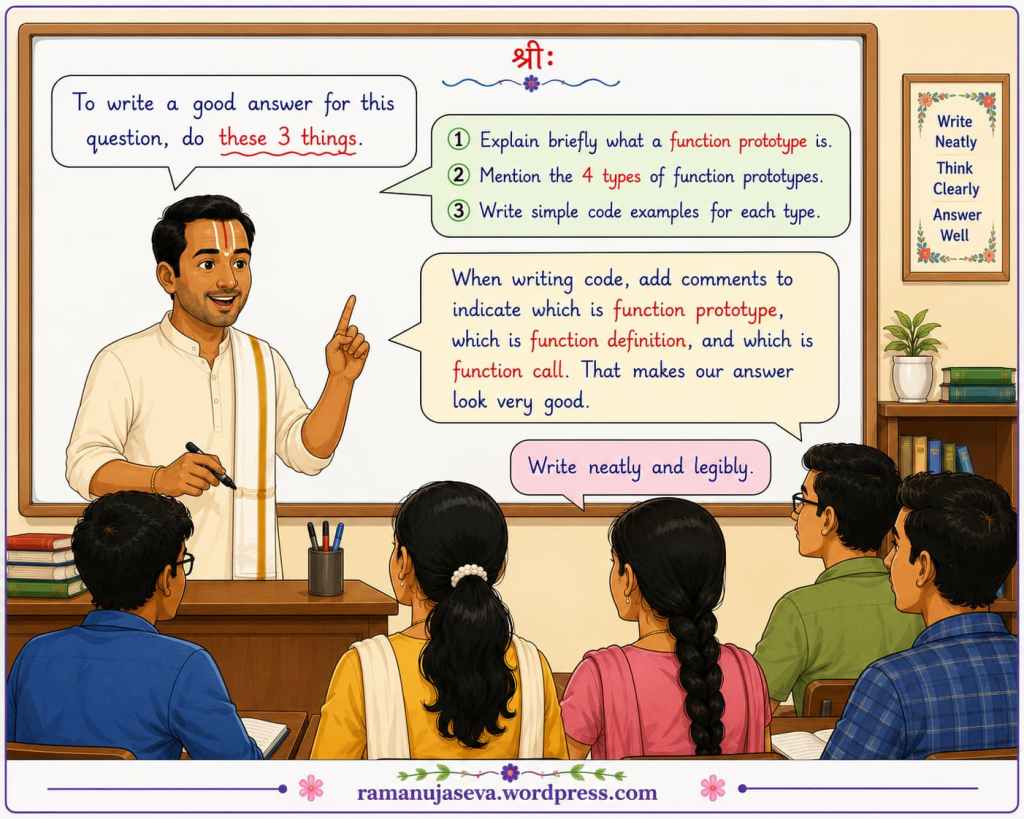
Pls see the above images. The same content is given in text form below.
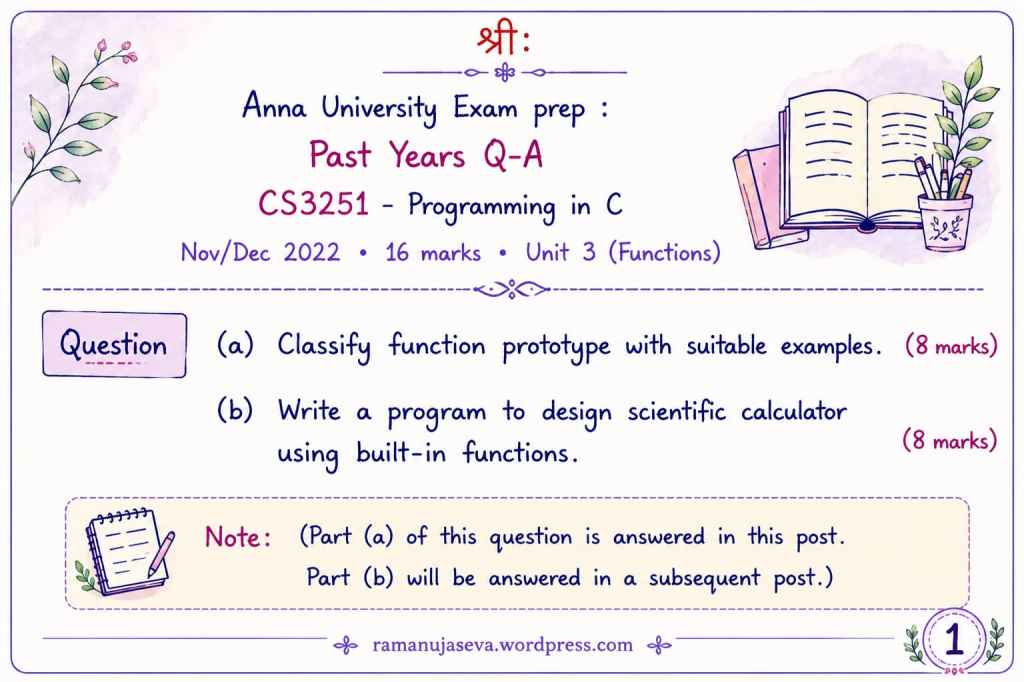
Anna Univ Exam Prep: CS 3251: Programming in C: Previous Years Questions and Answers – Part 5.
In this post, Q&A related to Functions (Unit 3).
Question (Nov / Dec 2022) (16 marks)
(a) Classify function prototypes with suitable examples. (8 marks)
(b) Write a program to design scientific calculator using built-in functions. (8 marks)
Note: Part (a) of this question is answered in this post. Part (b) will be answered in a subsequent post.
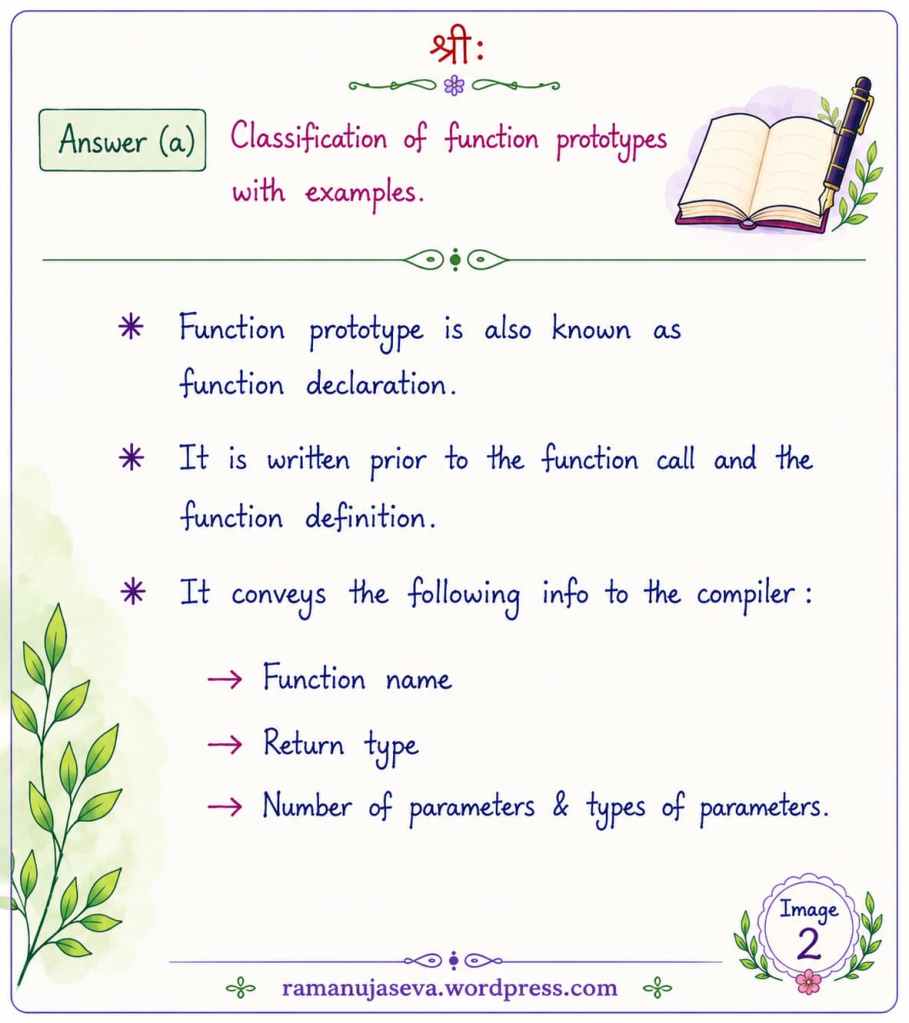
Answer (a) Classification of function prototypes, with examples.
- Function prototype is also known as function declaration.
- It is written prior to the function call and the function definition.
- It conveys the following information to the compiler:
- Function name
- Return type
- Number of parameters and types of parameters
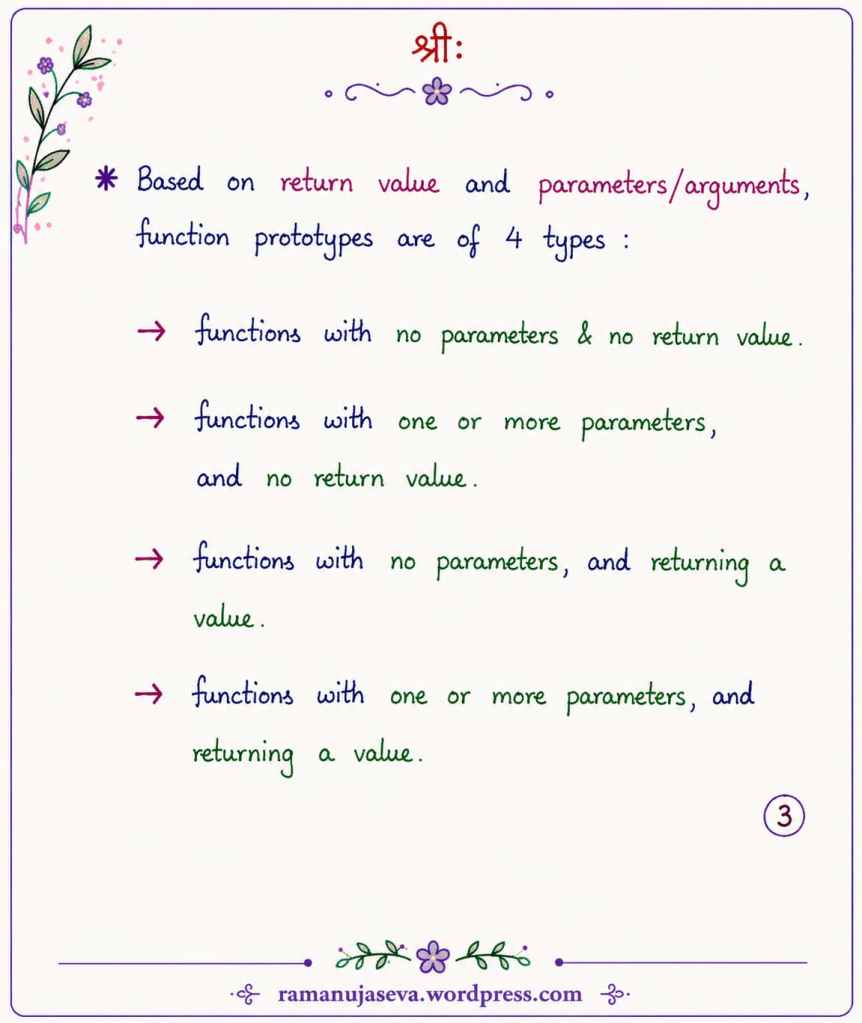
Based on return value and parameters/arguments, function prototypes are of 4 types:
- Functions with no parameters and no return value.
- Functions with one or more parameters, and no return value.
- Functions with no parameters, and returning a value.
- Functions with one or more parameters, and returning a value.
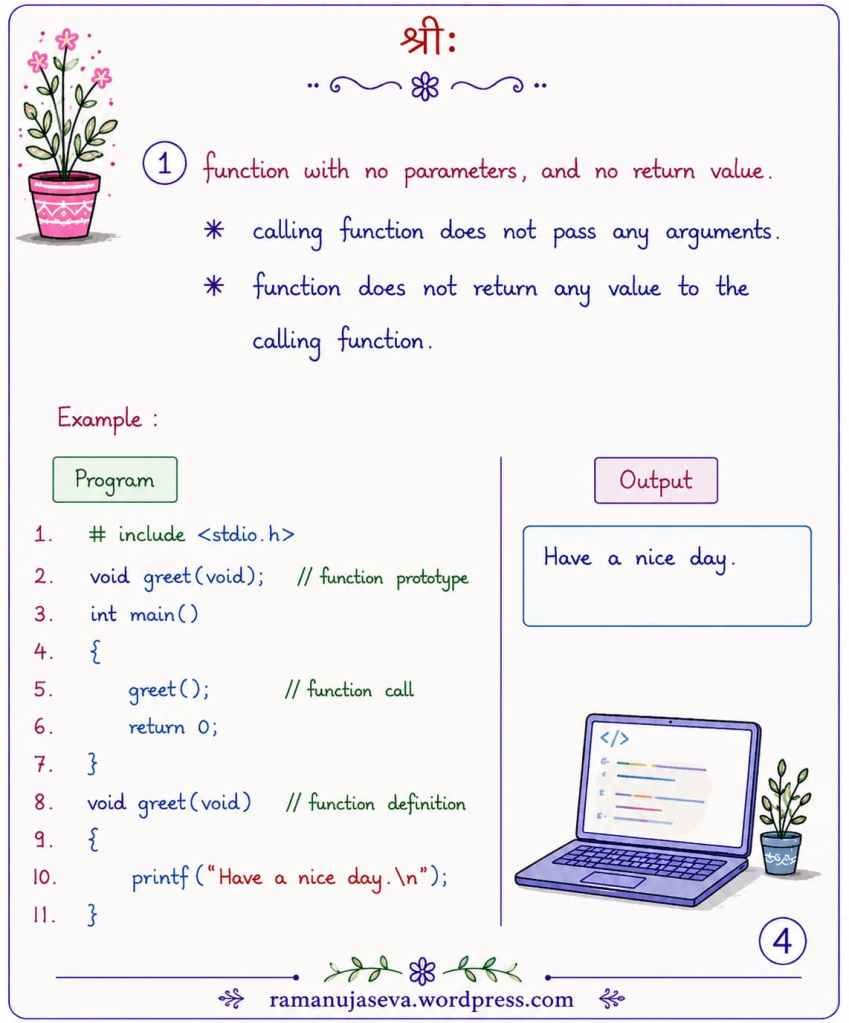
1. Function with no parameters, and no return value
- Calling function does not pass any arguments.
- Function does not return any value to the calling function.
<stdio.h>void greet(void); // function prototypeint main(){ greet(); // function call return 0;}void greet(void) // function definition{ printf("Have a nice day.\n");}
output: Have a nice day.
2. Function with one or more parameters, and no return value
- Calling function passes one or more parameters (arguments).
- Function does not return any value to the calling function.
<stdio.h>void Add(int, int); // function prototypeint main(){ Add(10, 20); // function call return 0;}void Add(int m, int n) // function definition{ printf("Sum of %d and %d is %d", m, n, m + n);}
output: Sum of 10 and 20 is 30
3. Function with no parameters, and returning a value
- Calling function does not pass any parameters (arguments).
- Function returns a value to the calling function.
<stdio.h>int getCurrentYear(void); // function prototypeint main(){ printf("Current year is %d", getCurrentYear()); // function call return 0;}int getCurrentYear(void) // function definition{ return 2026;}
output: Current year is 2026
4. Function with one or more parameters, and returning a value
- Calling function passes one or more parameters (arguments).
- Function returns a value to the calling function.
<stdio.h>int Add(int, int); // function prototypeint main(){ printf("Sum of %d and %d is %d", 10, 20, Add(10, 20)); // function call return 0;}int Add(int m, int n) // function definition{ return m + n;}
output: Sum of 10 and 20 is 30
To write a good answer for this question, do these things –
- Explain briefly what a function prototype is.
- Mention the 4 types of function prototypes.
- Write simple code examples for each type.
- When writing code, add comments to indicate which is function prototype, which is function call, and which is function definition.
- write neatly and legibly.
 sri ramanuja seva
Leave a comment