(For part 1 of this tutorial on recursion, pls click here: Recursion – Part 1.)
In this lesson, we shall look at a few more simple problems on recursion, and their solutions.
Problems covered in this lesson:
- Find sum of numbers from 1 to n.
- Find n! (n factorial)
- Find 2^n (2 raised to the power n)
- Find a^n (a raised to the power n)
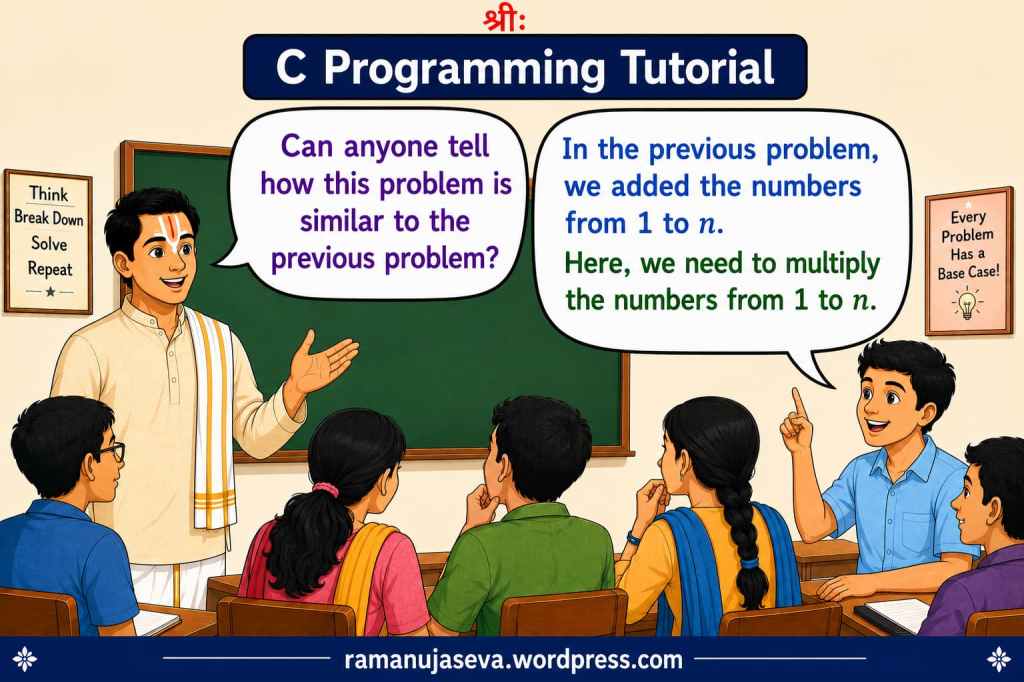
What is recursion?
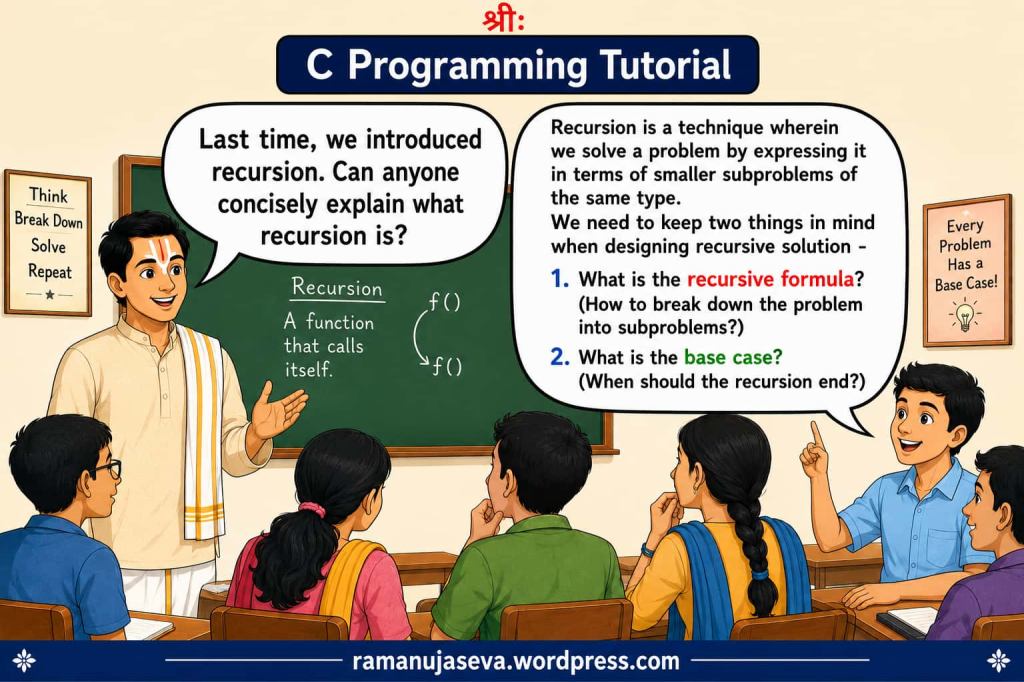
Recursion is the technique of breaking down a problem into similar problems of smaller size, and then again breaking down those smaller problems into still more smaller problems, and so on. That is, we solve a problem by expressing it in terms of a smaller problem of the same type.
Two things to keep in mind in designing recursive solutions –
- What is the recursive formula? (How can we express the problem in terms of a smaller problem of the same type?)
- What is the base case? (When should the recursion end? What is that small problem for which we directly know the answer?)
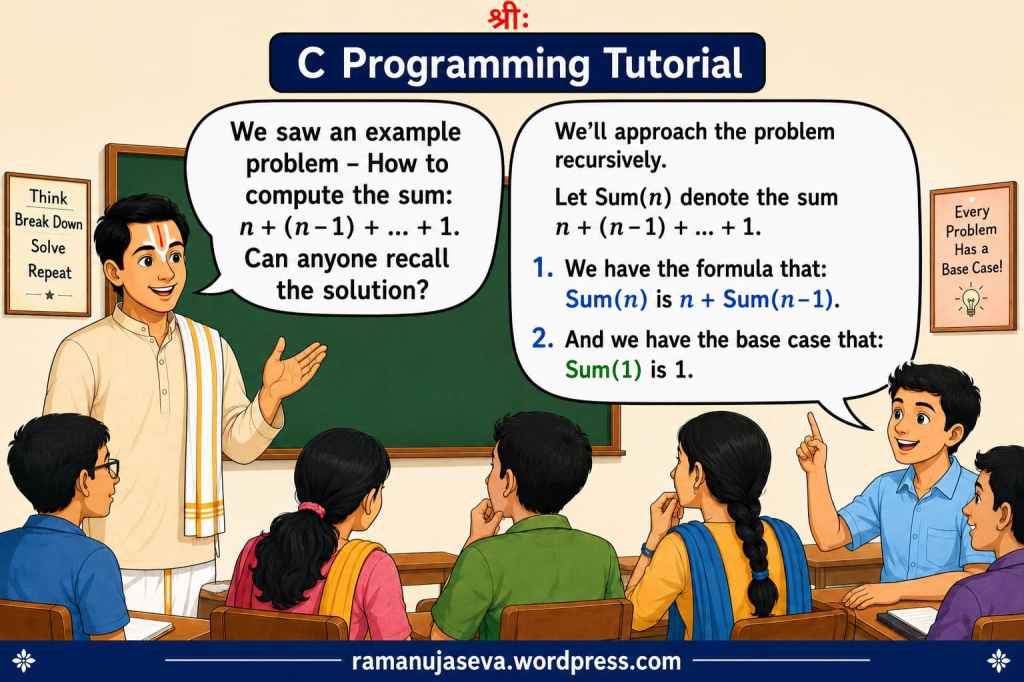
Q.1. Compute the sum 1 + 2 + … + n, recursively.
Solution.
Let Sum(n) denote the sum n + (n-1) + … + 1.
- Recursive formula: Sum(n) is n + Sum(n-1).
- Base case: Sum(1) is 1.
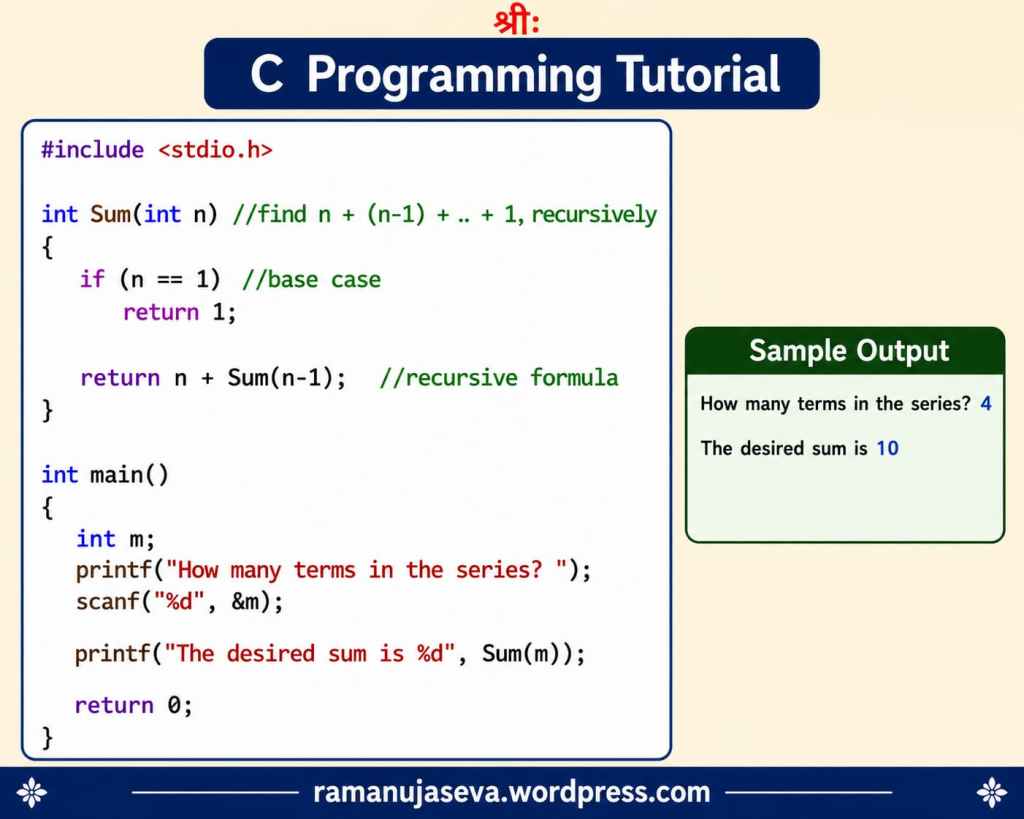
// Program to compute 1 + 2 + ... + n, recursively. <stdio.h>int Sum(int n) //recursive function to find n + (n-1) + ... + 1{ if (n == 1) //base case return 1; return n + Sum(n - 1); //recursive formula}int main(){ int m; printf("How many terms in the series? "); scanf("%d", &m); //get input from user. printf("The desired sum is %d", Sum(m)); //call the function return 0;}
Sample output: How many terms in the series? 4The desired sum is 10
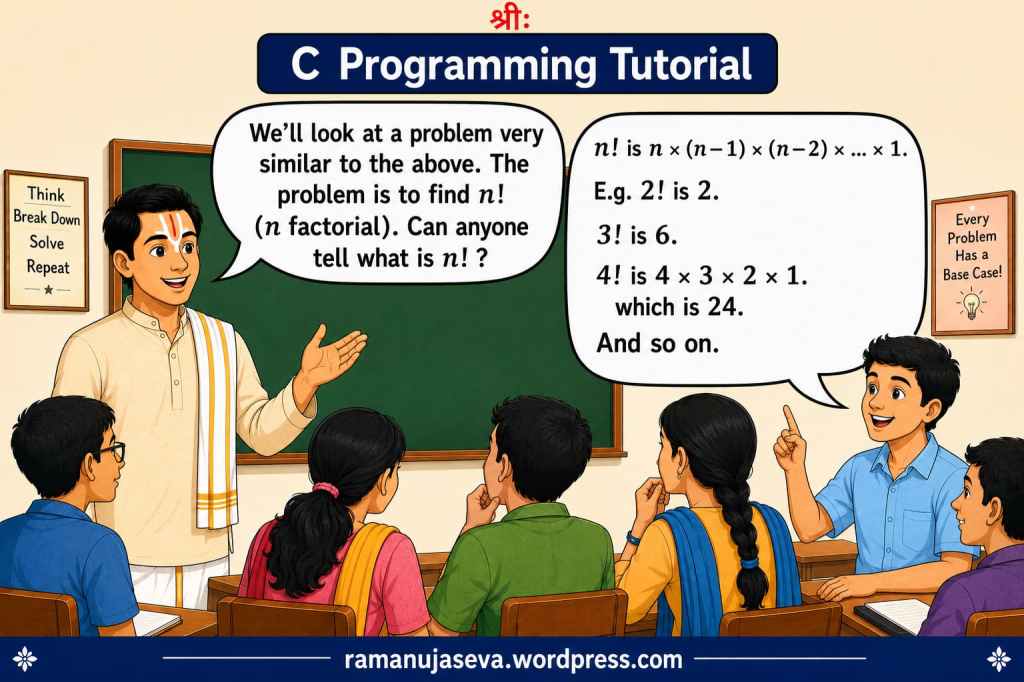
Q.2. Compute n! (n factorial) recursively.
Solution.
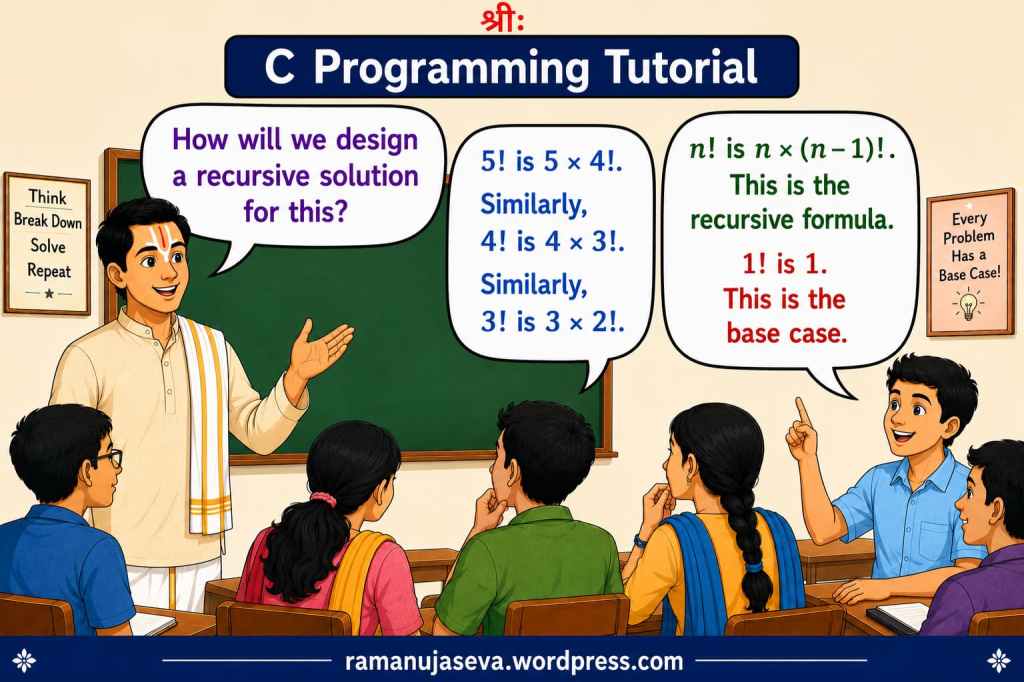
- Recursive formula: n! is n x (n-1)!
- Base case: 1! is 1.
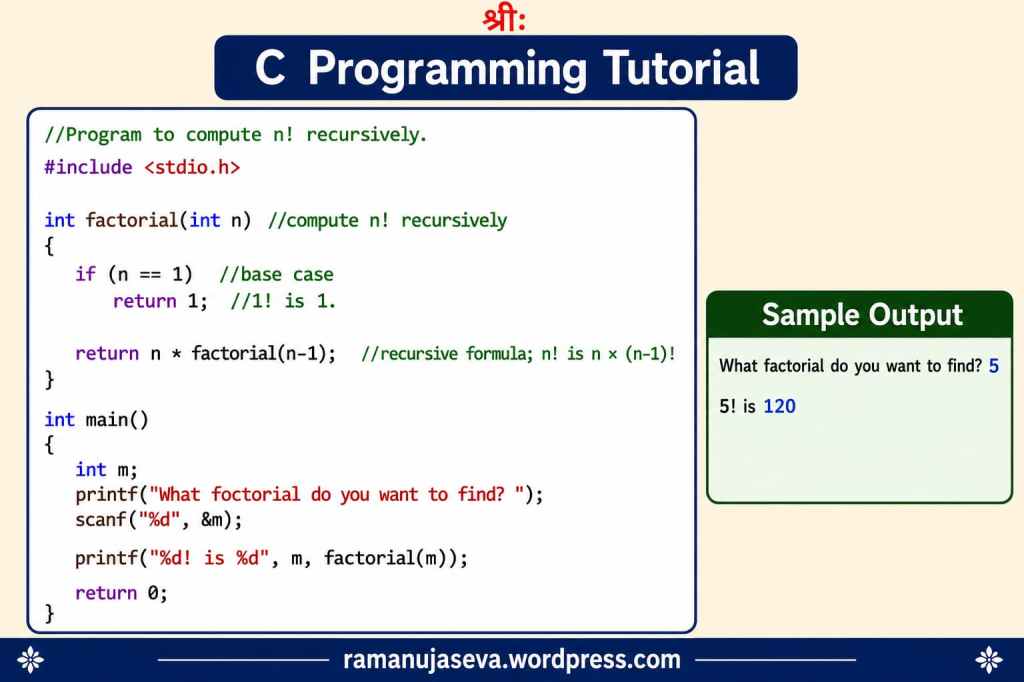
//Program to compute n! recursively. <stdio.h>int factorial(int n) //compute n! recursively{ if (n == 1) //base case return 1; //1! is 1. return n * factorial(n - 1); //recursive formula; n! is n x (n-1)!}int main(){ int m; printf("What factorial do you want to find? "); scanf("%d", &m); printf("%d! is %d", m, factorial(m)); //display the result. return 0;}
Sample output: What factorial do you want to find? 55! is 120
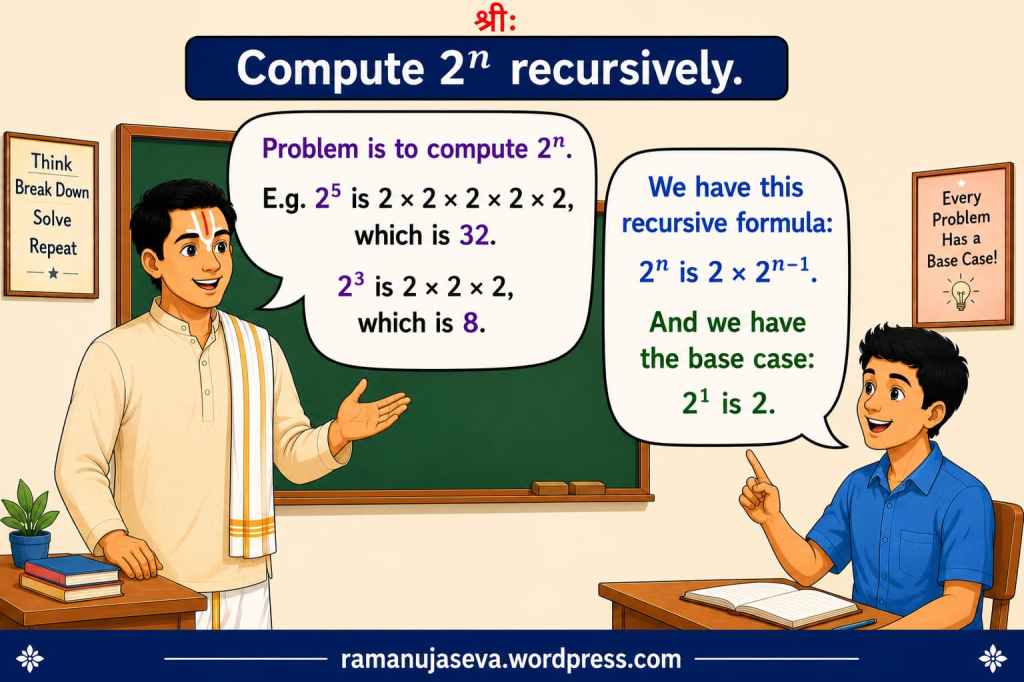
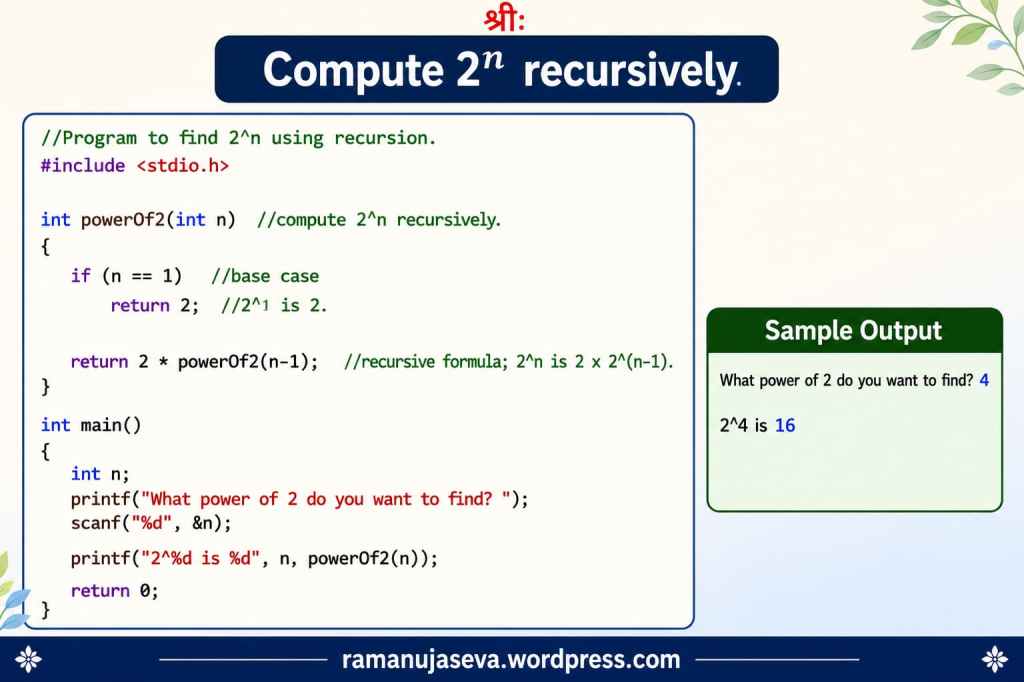
Q.3. Compute 2^n recursively.
Solution.
- Recursive formula: 2^n is 2 x 2^(n-1).
- Base case: 2^1 is 2.
//Program to find 2^n using recursion. <stdio.h>int powerOf2(int n) //compute 2^n recursively.{ if (n == 1) //base case return 2; //2^1 is 2. return 2 * powerOf2(n - 1); //recursive formula; 2^n is 2 x 2^(n-1).}int main(){ int n; printf("What power of 2 do you want to find? "); scanf("%d", &n); printf("2^%d is %d", n, powerOf2(n)); return 0;}
sample output: What power of 2 do you want to find? 42^4 is 16
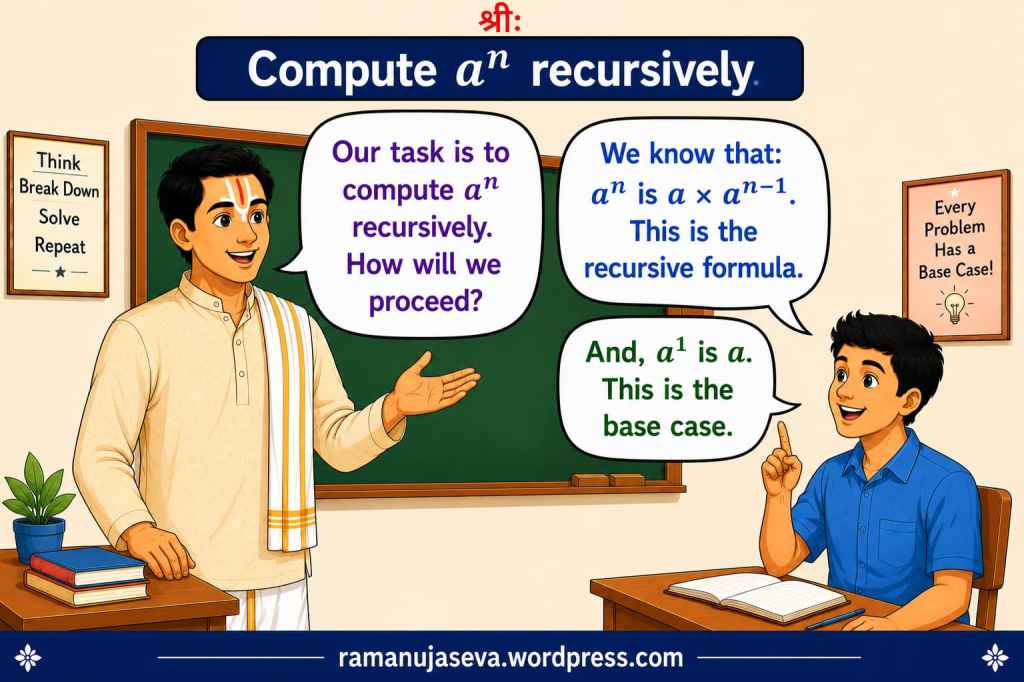
Q.4. Compute a^n recursively.
Solution.
- Recursive formula: a^n is a x a^(n-1).
- Base case: a^1 is a.
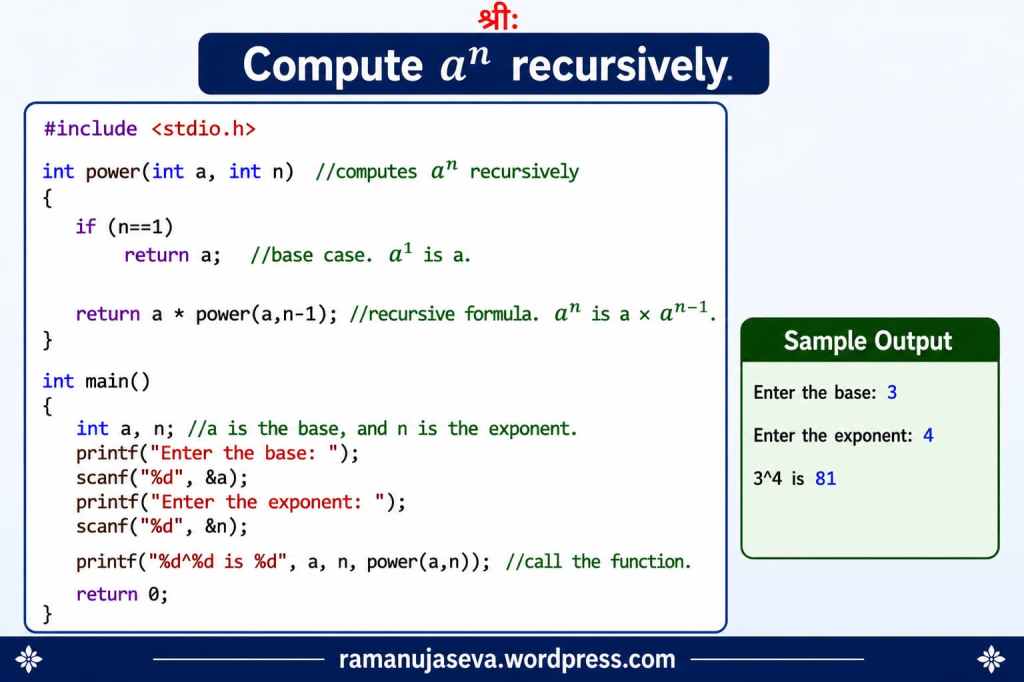
<stdio.h>int power(int a, int n) //computes a^n recursively{ if (n == 1) return a; //base case. a^1 is a. return a * power(a, n - 1); //recursive formula. a^n is a x a^(n-1).}int main(){ int a, n; //a is the base, and n is the exponent. printf("Enter the base: "); scanf("%d", &a); printf("Enter the exponent: "); scanf("%d", &n); printf("%d^%d is %d", a, n, power(a, n)); //call the function. return 0;}
sample output: Enter the base: 3Enter the exponent: 43^4 is 81
In this lesson, we saw a few problems on recursion. identified the recursive formula and base case for those problems, and translated that into C code.
(For the next part of this tutorial on recursion, pls see here: Recursion – Part 3.)
(For more on C Programming, you can click here: Posts on C Programming)
 sri ramanuja seva
Leave a comment